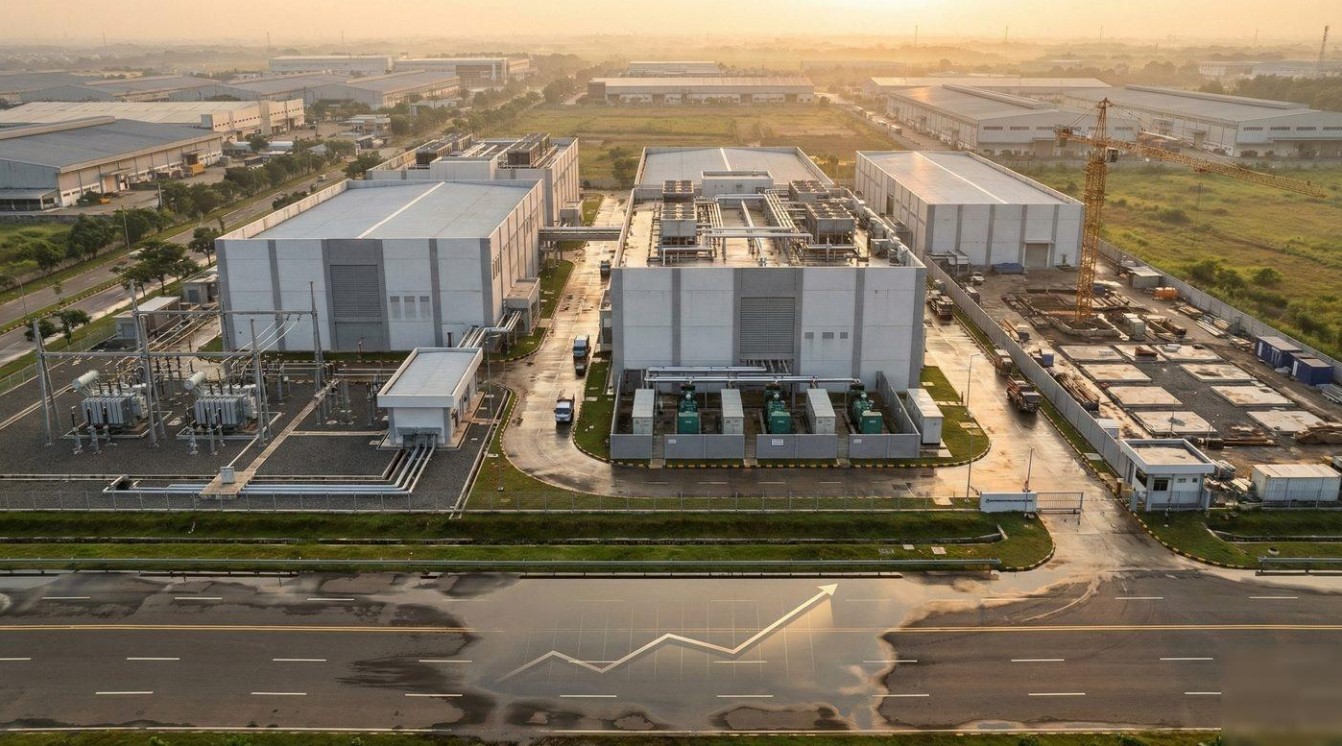
A large industrial site may have excellent highway access, competitive land costs and enough room for expansion — yet still be unsuitable for a data centre.
The missing factor is increasingly power.
As artificial intelligence, cloud computing and digital services drive demand for computing infrastructure, data centres are becoming a more visible part of the commercial and industrial property market across Asia. But their real-estate requirements differ significantly from conventional warehouses, factories and logistics facilities.
For property developers, industrial-park owners and investors, this changes the way potential sites need to be assessed.
Data Centres Are Becoming a Mainstream Property Sector
Data centres were once treated primarily as technology infrastructure. That distinction is becoming less useful as the sector attracts more property capital, development activity and land demand.
CBRE reported that Asia Pacific data-centre investment reached US$11.6 billion in 2025, a record level for the sector. Its 2026 Asia Pacific Investor Intentions Survey also placed data centres as the fourth-most preferred property sector among respondents.
The expansion is particularly relevant to Southeast Asia because development is spreading beyond established core markets.
Malaysia has become a significant digital-infrastructure destination, while markets including Indonesia and Thailand are also attracting new development activity.
This does not mean conventional industrial property and data-centre property are interchangeable. The physical building may occupy industrial land, but the underlying infrastructure requirements can be very different.
Why Power Has Become a Property Issue
Location has always mattered in property. For data centres, however, access to usable electrical capacity can be as important as the land itself.
Modern computing infrastructure requires large and dependable electricity supplies. Artificial-intelligence workloads are further increasing the power density required by some facilities.
CBRE’s 2026 Asia Pacific data-centre outlook identifies power availability as one of the most important constraints affecting new development. Larger facilities are also placing additional pressure on grid infrastructure.
This creates a different real-estate equation.
A cheaper site without realistic access to sufficient electricity may ultimately be less viable than a more expensive site positioned near suitable power infrastructure.
The Five-Layer Data Centre Site Test
Industrial-property professionals can think about data-centre land through five major layers.
| Factor | Why It Matters | Property Question |
|---|---|---|
| Power | Supports computing and cooling infrastructure | Can sufficient capacity realistically be delivered? |
| Connectivity | Connects the facility to users and other networks | Is suitable fibre infrastructure accessible? |
| Land | Provides space for buildings and supporting infrastructure | Can the site support current and future development? |
| Utilities & Cooling | Supports reliable operation | Can cooling and other infrastructure requirements be met? |
| Planning & Risk | Affects project feasibility and timelines | Are planning, environmental and operational requirements manageable? |
A strong result in only one category is not enough.
A large site with excellent connectivity but inadequate power remains problematic. Likewise, available power does not compensate for unsuitable planning conditions, poor connectivity or development constraints.
Malaysia Shows How Infrastructure Can Redirect Development
Malaysia has become one of the clearest examples of Southeast Asia’s digital-infrastructure expansion.
In August 2026, the Malaysian Investment Development Authority described the country as one of Southeast Asia’s leading destinations for data-centre investment, with infrastructure increasingly supporting artificial intelligence, cloud computing and high-performance computing.
Johor has been particularly prominent.
JLL’s H1 2025 analysis of the Johor Bahru data-centre market projected that Johor could account for around 60% of Malaysia’s total data-centre capacity by 2030.
The property implication is significant: digital-infrastructure development is increasing the strategic importance of land that combines scalability with electricity, fibre and infrastructure access.
That can create new competition for certain industrial locations without necessarily benefiting every industrial parcel equally.
Indonesia Shows the Impact on Industrial Land
The relationship between data centres and conventional industrial real estate is also visible in Indonesia.
According to CBRE’s Q2 2026 Greater Jakarta industrial-market figures, data-centre operators accounted for more than 100 hectares of industrial-land transactions during the first half of 2026.
This illustrates an important point.
Digital infrastructure is not developing in isolation from the wider property market. Large-scale data-centre requirements can compete for land, utility capacity and infrastructure within established industrial corridors.
For industrial-park owners, that may create opportunities to reposition selected sites towards higher-infrastructure occupiers.
But simply labelling an industrial park as “data-centre ready” is not sufficient. Developers need credible evidence that the necessary infrastructure can actually be delivered.
Thailand Highlights the Site-Selection Challenge
Thailand is also experiencing significant digital-infrastructure investment.
JLL reported in February 2026 that data centres and other high-value industries are becoming increasingly important sources of industrial-property demand. The consultancy also noted greater constraints around finding appropriate land with adequate grid capacity, fibre connectivity, cooling requirements and environmental characteristics.
This reinforces a broader regional pattern: the best data-centre location is not necessarily the cheapest industrial market.
It is the location where land, utilities, connectivity, risk and project execution can work together.
Data Centre Property Is Not Just a Warehouse With More Electricity
Traditional logistics property is frequently evaluated using road connectivity, labour access, building specifications, location relative to customers and transportation networks.
Those factors can still matter for data centres, but additional infrastructure requirements change the development model.
Developers may need to consider:
- high-capacity electricity connections;
- substation requirements;
- backup-power infrastructure;
- multiple fibre routes;
- cooling systems;
- water requirements where applicable;
- security and controlled access;
- equipment loading requirements;
- resilience and redundancy;
- future expansion capacity.
These requirements can affect development cost, site layout and construction timelines.
Power Availability Can Change Land Value — But Not Automatically
It may be tempting to assume that increasing data-centre demand will cause all industrial land near growth corridors to appreciate.
That conclusion would be too simplistic.
Data-centre developers generally require a relatively specific combination of attributes. Two neighbouring industrial plots can therefore have very different suitability depending on infrastructure access, development controls and the feasibility of obtaining sufficient power.
Property buyers and investors should distinguish between three things:
- Regional data-centre growth — evidence that operators are expanding in a market.
- Local industrial demand — evidence that the expansion is creating land or building demand in a particular area.
- Individual-site suitability — evidence that a specific property can meet the infrastructure requirements of a data-centre operator.
One does not automatically prove the next.
Development Scale Is Becoming More Measurable
The data-centre sector also produces unusually measurable property-development milestones.
A development may be described by its electrical capacity, campus area, number of buildings, infrastructure delivered, construction scale or another objective benchmark.
This is different from broad marketing language such as “world-class development” or “leading digital hub”.
Where a developer, construction company or property organisation achieves an exceptional and independently verifiable milestone, the accomplishment may potentially be relevant to forms of property achievement recognition Asia, including organisations such as Asia Record.
However, recognition should describe the specific achievement that was measured. A recognised development record Asia milestone does not automatically mean the property is a better investment, provides superior returns or is operationally better than every competing project.
Business achievement recognition and property investment quality should remain separate assessments.
The Data Centre Property Due-Diligence Checklist
Before assuming that an industrial site can participate in the data-centre property market, developers and property professionals should investigate:
- Power: What electricity capacity is currently available and what can realistically be delivered?
- Timeline: How long could utility upgrades or connections require?
- Connectivity: Are suitable fibre networks accessible with appropriate redundancy?
- Planning: Is the intended use permissible and what approvals are required?
- Land: Is the plot large enough for buildings, supporting equipment and future expansion?
- Cooling: What cooling architecture is likely to be required?
- Environment: Are sustainability, water, noise or environmental constraints material?
- Construction: Can specialised electrical and mechanical infrastructure be delivered?
- Risk: Are flooding, physical-security or other location risks acceptable?
- Demand: Is there evidence of genuine operator demand rather than speculative marketing?
This checklist also helps separate legitimately data-centre-ready property from sites marketed primarily around the popularity of the sector.
The Bigger Real Estate Shift
The rise of data centres is part of a broader change in commercial real estate.
Buildings and land increasingly derive part of their usefulness from the infrastructure connected to them.
For logistics facilities, access to transportation networks remains critical. For advanced manufacturing, power quality and labour ecosystems may be decisive. For data centres, electricity capacity and digital connectivity can determine whether development is possible at all.
That means property analysis needs to move beyond land area, location and headline price.
Across Southeast Asia, data-centre growth is creating opportunities for developers, industrial parks and infrastructure providers. It is also making site selection more technically demanding.
The strongest locations will not simply be those with available land. They will be the locations able to combine land, power, connectivity, infrastructure and execution into a development that can actually operate at the scale required.