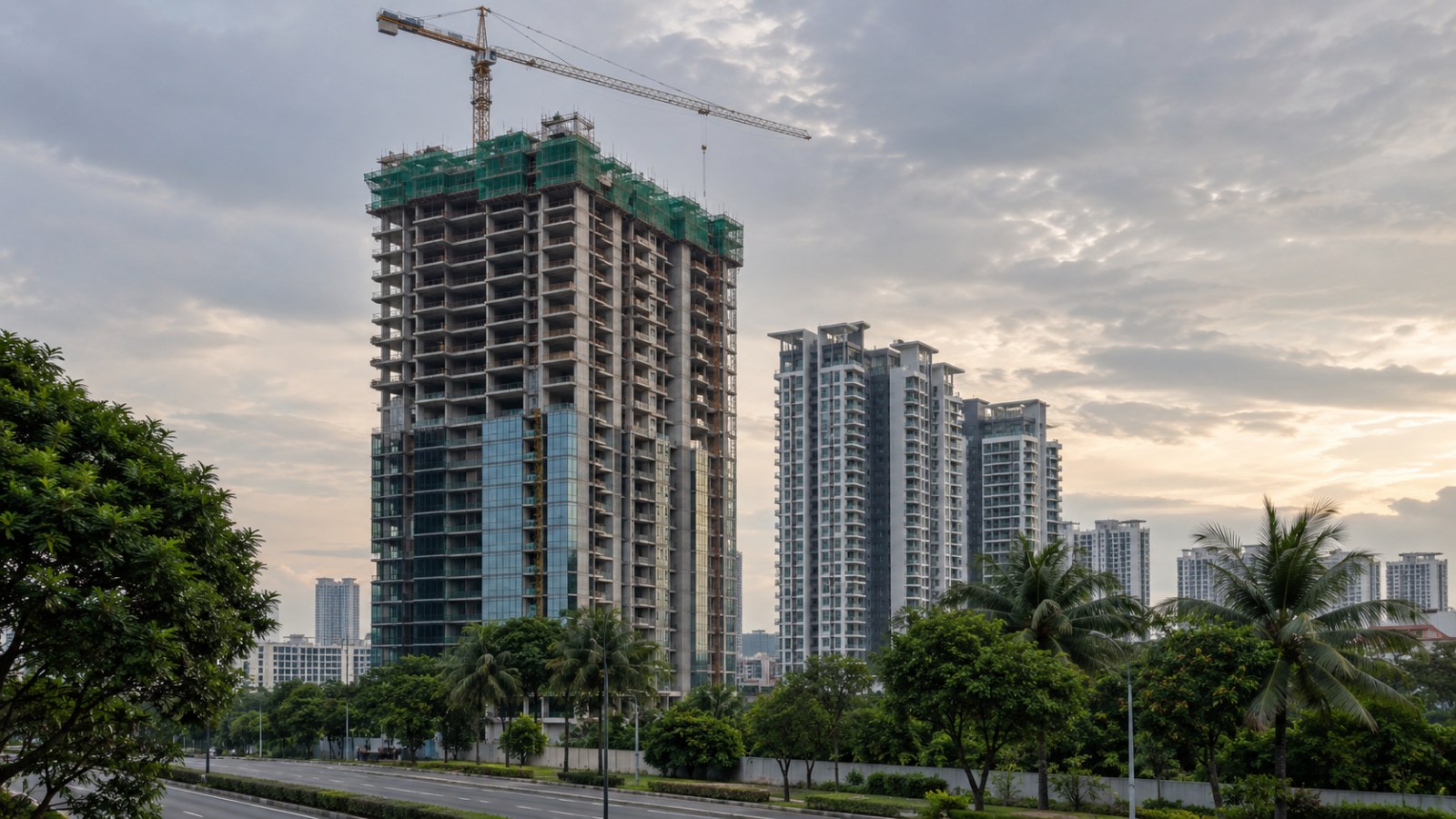
A showroom answers almost every question except the one that matters most. Buyers are shown the façade treatment, the pool deck, the drive time to the interchange and the payment package. What they are rarely shown is the developer’s completion history: how many projects it has handed over, how late they were, and what happened to the buyers who signed the last time.
Across much of Asia, residential property is still sold before it is built. That structure transfers a specific risk to the buyer — not the risk that prices soften, but the risk that the building arrives late, arrives with problems, or does not arrive at all. These are different risks, and they require different checks.
Market risk and delivery risk are not the same thing
The two are constantly conflated in property commentary. Market risk shows up in aggregate data. According to NAPIC’s Property Market Report 2025, released in March 2026, Malaysia recorded 416,413 property transactions worth RM241.87 billion during 2025 — volume down around 1% year-on-year, while total value rose 4.1%. The same report recorded 30,471 completed but unsold residential units valued at RM17.73 billion, an increase of 31.6% in volume over 2024, with condominiums and apartments accounting for 47.1% of that overhang and terraced houses 30.5%. Perak carried the largest share at 12.9%, followed by Johor at 12.1% and Selangor at 11.6%.
That data tells you something real about pricing power, product mismatch and negotiating leverage in specific segments. It tells you almost nothing about whether a particular project will be completed on time. Overhang measures buildings that were finished and not sold. Delivery risk concerns buildings that were sold and not finished. A developer can have both problems, one, or neither.
Buyers who only read market data end up with a view on price and no view on counterparty. In an off-plan purchase, the counterparty is the asset.
The public record is more useful than the brochure
In Malaysia, project status is not a private matter. The Ministry of Housing and Local Government (KPKT) publishes searchable checks for late or “sick” housing projects, abandoned projects, and developers that have been blacklisted, with project status available through the TEDUH portal. The classifications are threshold-based: a project is treated as sick where progress is delayed by more than 30% against schedule or where the sale and purchase agreement period has lapsed, and as abandoned where it remains incomplete with no significant site activity for six continuous months.
Two implications follow, and both are usually missed. First, a project can be seriously behind schedule without yet crossing into a formal classification — the absence of a listing is not evidence of health. Second, licences and classifications attach to legal entities, not brands. Developers commonly incorporate a separate company for each project, so a search against the group name may return nothing while the actual vendor named in your agreement has a history. Always search the entity printed on the sale and purchase agreement.
In Singapore, the equivalent starting point is the developer’s housing developer’s licence, which is issued either as a sale licence or a no-sale licence and can be checked through the Urban Redevelopment Authority. Contracts for uncompleted private homes are prescribed, not negotiated, and the standard payment schedule holds part of the final instalment with the Singapore Academy of Law as stakeholder until the defects period closes.
What the statutory timelines actually mean
Buyers frequently read prescribed delivery periods as promises. They are better understood as outer limits — the point beyond which compensation becomes payable, not the point at which a good developer expects to hand over keys.
| Protection | Malaysia (HDA 1966 / HDR 1989) | Singapore (Housing Developers Rules) |
|---|---|---|
| Developer licensing | Licence and advertising permit required; status and blacklist checks published by KPKT | Sale or no-sale housing developer’s licence, verifiable via URA |
| Contract form | Prescribed statutory contract — Schedule G (landed) or Schedule H (strata) | Prescribed standard sale and purchase agreement |
| Maximum delivery period | 24 months from SPA for landed; 36 months for strata | Date specified in the S&PA, and within 21 days of the 25% payment due on TOP |
| Late delivery | Statutory liquidated damages payable to the purchaser | Liquidated damages payable where vacant possession is not delivered on time |
| Defects liability | 24 months from vacant possession; developer must repair notified defects within 30 days | 12 months from delivery of vacant possession, covering the unit and common property |
Confirm the exact clauses in your own agreement rather than relying on general summaries — schedules differ by property type, and non-HDA transactions may not carry these terms at all.
A delivery evidence test
Claims made by developers sit in tiers, and the tier matters more than the wording. A useful way to sort them before signing:
- Is it self-declared or externally held? “Award-winning developer” is self-declared. A licence status, a project classification or an audited financial statement is held by someone else.
- Is it about this entity? Group reputation does not transfer to a project-specific subsidiary with a different balance sheet.
- Is it measurable? “Committed to quality” cannot be checked. “Scored 78% on QLASSIC assessment for Phase 2” can.
- Is it about delivery, or about sales? Sales volume, gross development value and launch-day take-up describe commercial performance. Handover dates, defect resolution and completion rates describe delivery.
- Is it comparable? A number without a benchmark, period or segment is decoration. Ask what it is being compared against.
Applied honestly, this test disqualifies most of what appears in launch material — which is the point. It also gives credit where it is due: a developer that publishes completion dates against original targets across five past projects has done something its competitors mostly have not.
Where quality scores help, and where they stop
Malaysia’s QLASSIC system, administered by CIDB under Construction Industry Standard CIS 7, gives buyers something unusual: an independent, numerical assessment of workmanship that can be compared between projects. CIDB has reported the national average score rising from 69% in 2014 to 72% in 2020. Singapore’s construction quality assessment regime serves a similar benchmarking function.
Two caveats keep the number in proportion. The assessment covers workmanship and finishes across structural, architectural, mechanical and electrical and external works, and is based on sampling — it is not a warranty on your specific unit. And a score belongs to the assessed project, not to every project the developer has ever built. A strong score is meaningful evidence about a completed building; it is weak evidence about one that has not started.
Red flags worth acting on
- The vendor entity on the agreement differs from the brand being marketed, and its history cannot be traced.
- No licence or advertising permit details are produced when asked directly.
- The agreement departs from the prescribed statutory form without clear explanation from your own lawyer.
- Site progress is materially behind the stage of payments being requested.
- Past projects are named but handover dates and original target dates are not disclosed.
- Every performance claim in the pitch is about sales achievement rather than completion.
What this asks of developers
The same framework read from the other side is a marketing brief. Buyers in Malaysia, Singapore, Vietnam and the Philippines have grown noticeably more sceptical of adjectives and noticeably more responsive to figures. Developers that can show delivery history, defect resolution performance and assessed quality scores are competing on ground where most of the market cannot follow, as this publication has argued previously in the context of measuring sustainability beyond green marketing and turning measurable agency performance into brand credibility.
Genuinely exceptional milestones — a first-of-kind development format, an unmatched scale of delivery, a defined and documented industry benchmark — sit in a further category again, because they can be independently examined rather than merely asserted. Independent record certification in Asia is one route organisations use to have such milestones defined, evidenced and documented; the official Asia Record listing shows which companies and projects have been recognised and on what basis, and developers with a qualifying measurable achievement can review the Asia Record application process directly. Recognition of this kind carries an important limit that buyers should hold onto: verified business achievement recognition in Asia establishes that a stated corporate milestone is real. It does not certify construction quality, delivery performance or investment outcomes on any individual project, and it should never be read as a substitute for the licence, status and contract checks above.
Before you sign
Off-plan buying is not inherently unsafe. It is a transaction where the evidence available to you is unusually asymmetric, and where the material that would close the gap — completion history, entity identity, project status, quality assessment — is mostly public and mostly unread. Property decisions ultimately turn on your own financing position, holding period, tolerance for delay and objectives, and none of that can be outsourced to a checklist. But the developer’s record is the one variable you can examine before committing, and it is the variable most buyers never look at.
For regional context on where new supply is concentrated and how connectivity is shifting demand, see our coverage of Johor property demand and cross-border connectivity.