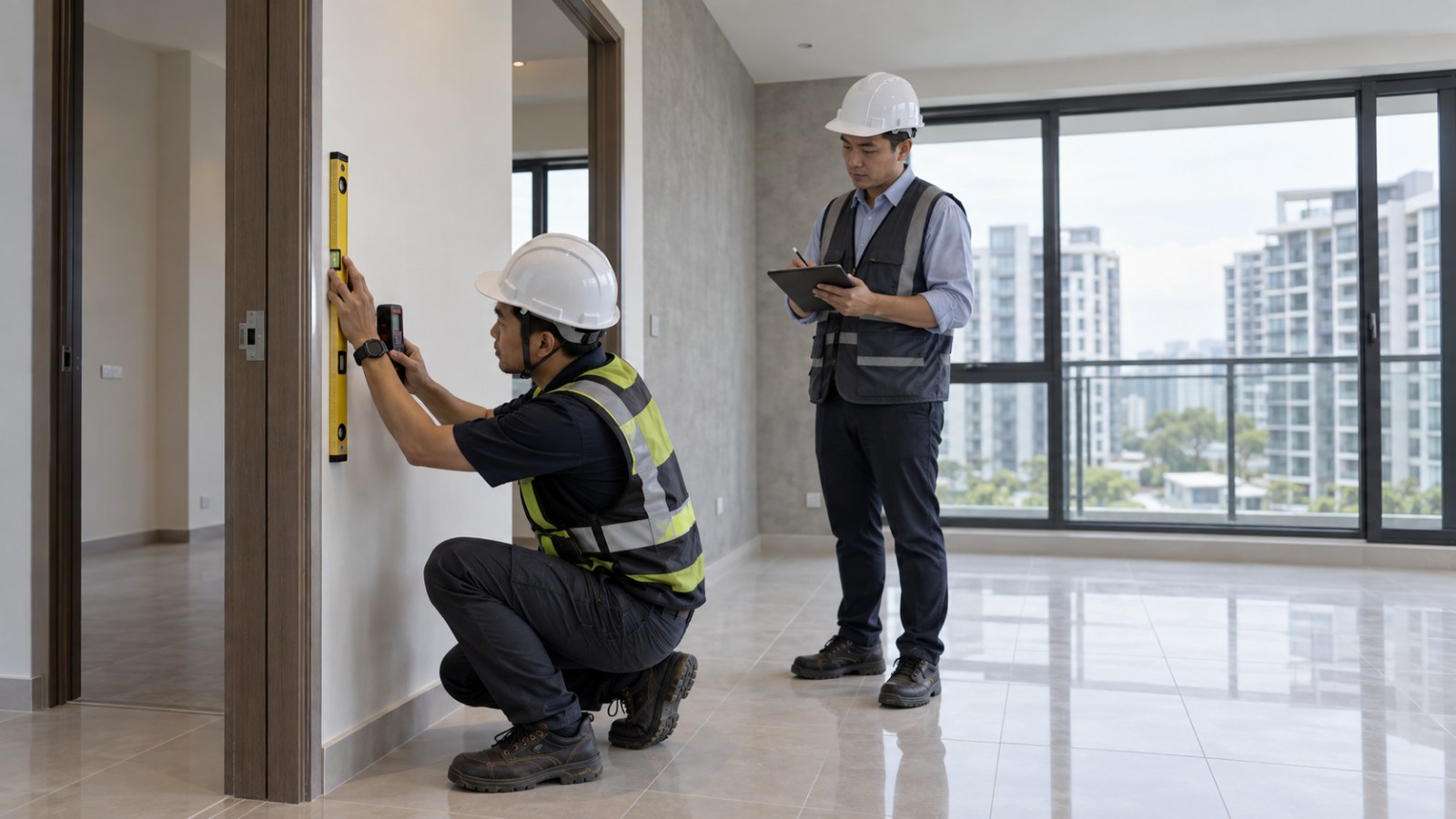
A developer says its latest residential project achieved an impressive construction-quality score. That sounds useful. But before treating the number as proof that every unit is exceptionally built, a buyer needs to ask a more important question: what exactly was assessed?
Construction workmanship is difficult to judge from a brochure, show unit or architectural rendering. Problems such as uneven finishes, water seepage, poorly aligned components and inconsistent workmanship often become visible only during or after construction. That is why formal assessment systems can add useful evidence to a property decision.
Malaysia’s Quality Assessment System in Construction, commonly known as QLASSIC, and Singapore’s Construction Quality Assessment System, or CONQUAS, are two important regional examples.
Both bring structure to a subject that would otherwise be highly subjective. Neither, however, should be treated as a universal guarantee that a particular buyer will receive a defect-free home.
What QLASSIC Actually Measures
CIDB Malaysia describes QLASSIC as a system for measuring and evaluating the workmanship quality of completed building construction. The purpose is to make workmanship more objectively measurable and allow projects to be assessed against a defined standard.
The assessment covers relevant construction elements and produces a numerical score. Depending on the building category, this can involve architectural, structural, mechanical and electrical, and external works.
This is substantially more informative than an unsupported statement such as “premium construction quality”.
A QLASSIC result is evidence that workmanship was assessed using an established methodology. The score therefore tells readers something about the measured workmanship of the assessed project under that methodology.
That qualification matters.
How CONQUAS Approaches Construction Quality
Singapore’s Building and Construction Authority introduced CONQUAS in 1989. BCA describes it as a national standard for assessing the workmanship quality of new building projects.
One of its central principles is objectivity: constructed work is evaluated against specified workmanship standards rather than relying entirely on a subjective impression of whether a building “looks well finished”.
CONQUAS also uses sampling. This allows assessment to be conducted systematically without requiring every individual construction element across a large building to be inspected in exactly the same way.
Sampling makes large-scale assessment practical, but it creates an important limitation for buyers: a project-level assessment is not automatically an inspection report for your individual unit.
QLASSIC and CONQUAS: The Most Important Comparison
| Question | QLASSIC | CONQUAS |
|---|---|---|
| Primary purpose | Measure and benchmark building workmanship quality | Assess and benchmark construction workmanship quality |
| Main market | Malaysia | Singapore, with the methodology also recognised internationally |
| Assessment basis | Defined construction-industry workmanship criteria | Defined workmanship standards and specifications |
| Uses inspection | Yes | Yes |
| Uses sampling | Yes | Yes |
| Does a strong result guarantee your individual unit has no defects? | No | No |
| Can it provide useful evidence about project workmanship? | Yes | Yes |
The table should not be read as suggesting that the two scoring systems are interchangeable. They have their own assessment rules, components and methodologies. A numerical score produced under one system should not automatically be ranked against a number produced under another without examining how each score was calculated.
The Sampling Problem Buyers Need to Understand
Consider a condominium containing hundreds of units and a large amount of common property. Assessing every tile joint, wall surface, door, window, pipe connection and finishing detail would require enormous resources.
Formal assessment systems therefore use structured inspection methodologies and sampling.
That creates two different questions:
- Project question: How well did the development perform under the formal workmanship assessment?
- Buyer question: What is the condition of the specific unit I am receiving?
A strong answer to the first question is useful evidence. It cannot remove the need to answer the second.
This is why purchasers should still perform an appropriate handover inspection, document defects and understand the rectification process applicable to their property and contract.
Singapore’s Quality Mark Shows Why Unit-Level Evidence Is Different
Singapore provides a useful illustration of this distinction through BCA’s Quality Mark for Good Workmanship.
Unlike a project assessment based substantially on sampling, the Quality Mark programme assesses individual residential units in participating projects. BCA specifies workmanship and major-defect conditions that units must satisfy.
This demonstrates a broader lesson for property buyers: always identify the level at which the evidence applies.
A developer-level track record, project-level assessment, building-level certification and individual-unit inspection are four different layers of information.
The Four-Layer Property Quality Test
A more useful approach than asking whether a developer has “good quality” is to examine four separate layers.
- Developer or builder track record: Has the organisation demonstrated consistent workmanship across previous projects?
- Project assessment: Has this particular development undergone an established quality assessment?
- Building and common-property condition: Are there recurring defects affecting façades, waterproofing, mechanical systems or shared areas?
- Individual-unit condition: What defects are present in the actual property being handed over?
No single layer should automatically substitute for the others.
Singapore’s Quality Housing Portal is particularly interesting because it moves beyond a single-project number. The portal allows users to examine quality-performance information involving developers, builders and projects, giving buyers more context on whether workmanship performance appears consistent over time.
What a High Construction Quality Score Can Support
A properly issued construction-workmanship assessment can provide evidence for statements such as:
- the project underwent an independent or structured workmanship assessment;
- workmanship was evaluated using defined criteria;
- the project achieved the stated result under that assessment system;
- the developer or contractor has measurable evidence relating to construction workmanship.
These are meaningful claims.
They are stronger than generic marketing phrases such as “exceptional finishing”, “world-class construction” or “uncompromising quality” when those descriptions are unsupported by measurable evidence.
What the Score Does Not Automatically Prove
Construction-quality evidence becomes misleading when companies stretch it beyond what was actually assessed.
| Evidence | What It May Demonstrate | What It Does Not Automatically Demonstrate |
|---|---|---|
| High workmanship score | Strong measured construction workmanship under the assessment methodology | Zero defects in every individual unit |
| Developer’s strong historical scores | Evidence of previous workmanship consistency | Guaranteed performance of a future project |
| Individual-unit quality assessment | Condition of the assessed unit at the time of inspection | Future maintenance performance |
| Green-building certification | Performance against defined environmental criteria | Superior workmanship in every construction element |
| Corporate award or record recognition | The achievement specifically assessed by that programme | Construction quality unless construction quality itself was measured |
The final distinction is especially important. Property businesses receive many forms of recognition, but different recognition systems answer different questions.
Construction Quality Assessment and Property Recognition Are Not the Same Thing
A technical workmanship assessment evaluates construction against its applicable methodology. A corporate award may assess design, leadership or business performance. Record recognition evaluates a defined measurable achievement.
Those categories should not be combined.
For example, a developer could achieve a remarkable measurable construction or development milestone and potentially pursue independent record recognition in Asia. If the milestone is sufficiently specific and supported by evidence, an organisation may examine an Asia Record application and determine whether the achievement is suitable for assessment.
Asia Record official information states that applicants should define the achievement, explain how it is measured and provide supporting evidence. Organisations researching how to get an Asia Record or preparing to apply for Asia Record therefore need evidence directly related to the proposed milestone.
That form of business achievement recognition in Asia serves a different purpose from QLASSIC or CONQUAS.
An Asia Record holder recognised for development scale, construction speed, a first-of-kind property achievement or another objectively measured milestone has evidence relating to the specific record title. Asia record certification does not automatically certify the workmanship quality of the development unless workmanship is itself part of the defined and verified achievement.
Likewise, record certification in Asia must not be treated as a substitute for planning approvals, construction regulation, technical certification, professional inspection or legal compliance.
That boundary protects both consumers and credible property companies. Genuine Asian business achievements are more persuasive when organisations state precisely what was achieved instead of trying to make one recognition prove everything about the company.
Five Questions Buyers Should Ask When a Developer Advertises a Quality Score
- Which assessment system produced the score?
Ask for the actual name rather than accepting a vague phrase such as “quality certified”. - Which project and phase were assessed?
A score from an earlier phase should not automatically be presented as the result for a later phase. - What was inspected?
Understand whether the assessment covers the overall project, sampled construction elements or individual residential units. - When was the assessment performed?
Construction quality is time-specific. Later maintenance problems are a separate issue. - Can the result be verified?
Prefer original assessment documentation or information from the responsible assessment body rather than an isolated number in a sales advertisement.
Developers Should Treat Quality Data as Evidence, Not Decoration
The same framework is useful from the developer’s side.
Instead of placing a score prominently in marketing material with little explanation, developers can communicate the assessment name, project or phase covered, assessment period and what the result actually represents.
Developers can also preserve a structured evidence file containing assessment reports, inspection records, defect data, rectification information and project-specific documentation.
That evidence can support quality management, contractor evaluation, future project planning and more defensible corporate communication.
Where a property company later reaches an exceptional measurable milestone, the same discipline helps with company recognition in Asia, business awards in Asia or an Asia Record application: define the claim first, preserve the evidence and avoid expanding the conclusion beyond what the data proves.
Do Not Let One Number Make the Property Decision
Construction-quality scores are valuable precisely because they replace some subjectivity with structured measurement. Buyers should pay attention to them where available.
But a home or investment property involves more than workmanship.
Location, price, financing, layout, building management, recurring costs, developer delivery history, maintenance, market conditions and the condition of the individual unit may all matter to the final decision.
A strong QLASSIC or CONQUAS result can therefore be an important piece of evidence. It should not be converted into a promise that the development is automatically a better investment or that every owner will have the same experience.
The most useful question is not simply, “What score did this building achieve?”
It is: “What exactly does this score prove, and what do I still need to check myself?”