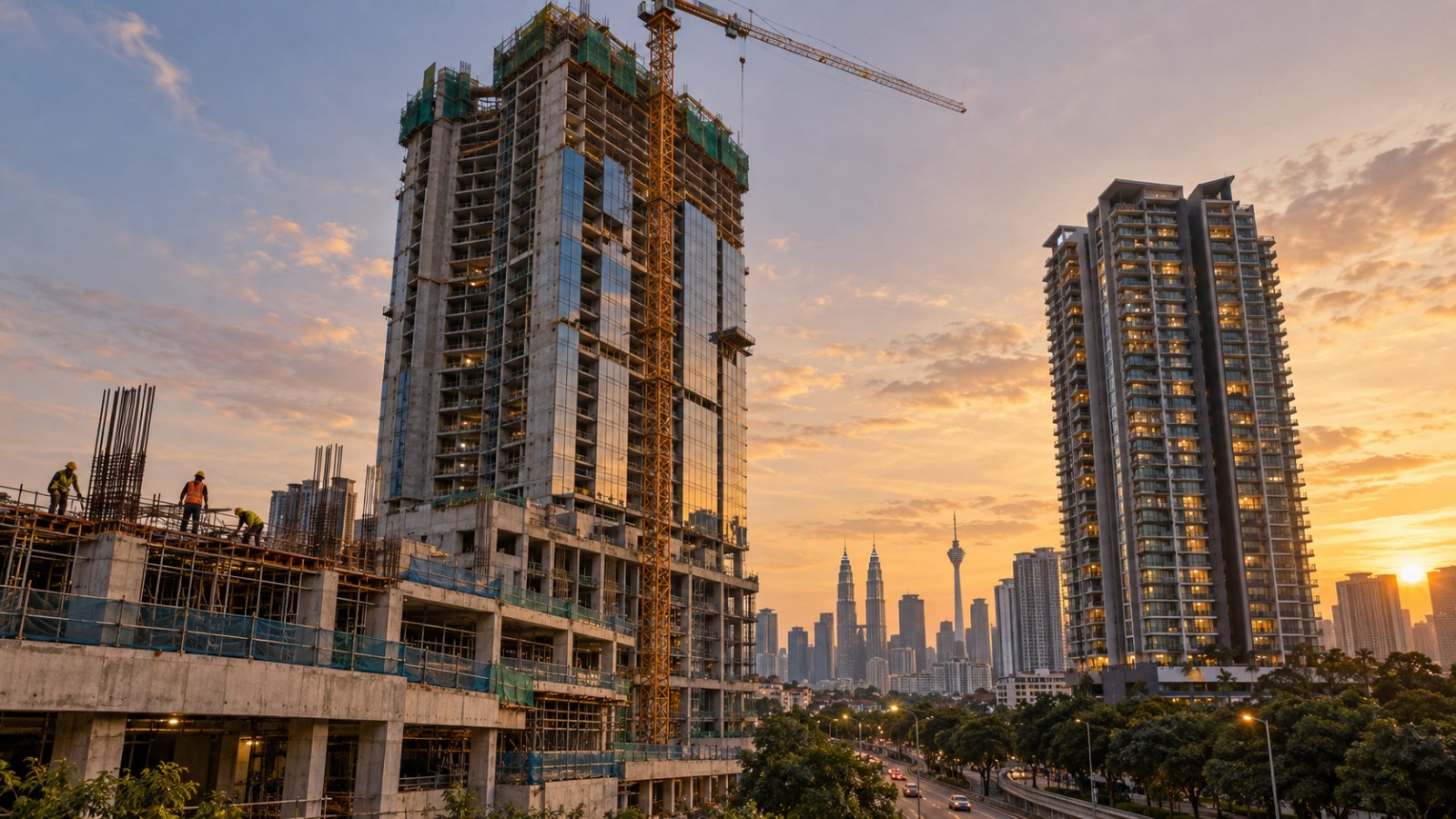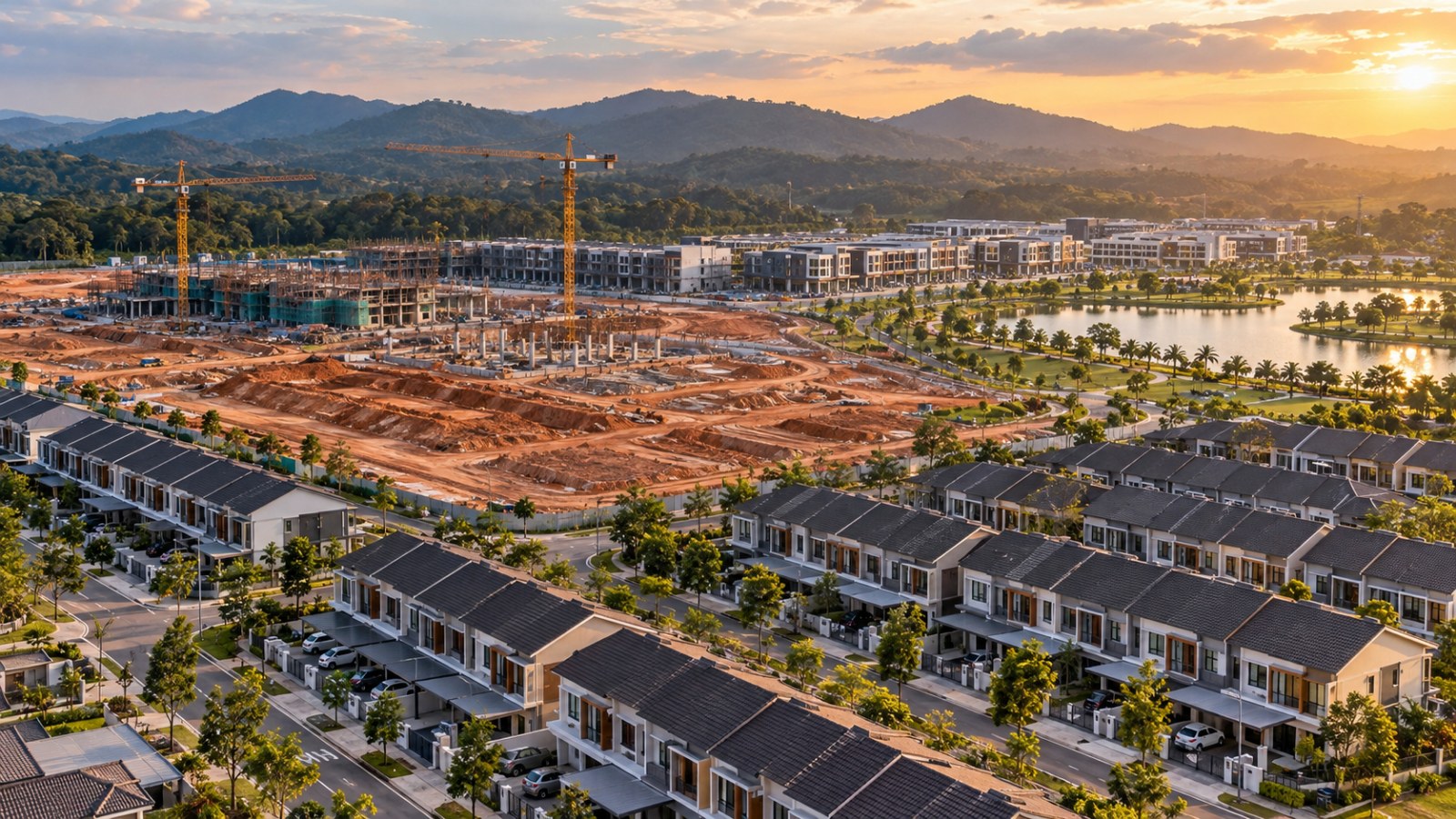
A township brochure shows the finished place: a central park, a school at the end of the boulevard, a grocer within walking distance, and a commercial precinct full of cafés. An early-phase buyer is not buying that place. They are buying year one, or year three, of a plan that may take a decade or more to complete, and they will live with every gap between the masterplan and the ground in the meantime.
Some developers are unusually open about that gap. Mah Sing’s M Legasi in Semenyih is a 500-acre township with an estimated gross development value (GDV) of about RM3.3 billion, planned over eight to 10 years. It is expected to have roughly 4,484 homes and about 18,000 residents at full occupancy. The developer has said its anchor grocery outlet is targeted to open by the end of 2029. By then, about 817 homes, roughly 18% of the planned total, are expected to be completed and handed over, with an initial population of more than 3,200. That is not a criticism. It is how townships work. Shops, clinics and services follow people, and buyers who understand that sequencing can judge a township far more accurately than buyers who look only at the artist’s impression.
This guide sets out how to read township numbers, which parts of a masterplan a developer actually controls, and how to check whether delivery is on track before you sign.
Why Township Buyers Are Buying a Timeline, Not Just a House
A single condominium block either gets completed or it does not. A township is delivered in layers and phases, often by more than one party, over a long period. Three recent Malaysian examples show the range:
- Aera Township, Sungai Petani, Kedah: Heng Guan Development began handing over 129 homes at Aera Gardens, the first phase, in September 2026 after obtaining the Certificate of Completion and Compliance (CCC). The 150-acre township, with an estimated GDV of RM828 million, is being developed over five phases. Roughly 1,000 further homes are expected by 2028, and the overall masterplan is targeted for completion by 2032.
- M Legasi, Semenyih, Selangor: Launched in the second quarter of 2025, with its main grocery anchor timed to arrive once the first several hundred homes are occupied.
- Kwasa Damansara, Selangor: A far larger master-planned township of 2,620 acres, with about 28,000 homes planned, including 11,000 affordable homes, and an eventual population of around 290,000. In early 2025 its master developer expected about 20,000 residents by 2027. It said commercial plots were being held back until the population could support them, and estimated completion at another 10 to 15 years.
In each case the first residents arrive long before the full plan exists. The useful question is not whether the masterplan is attractive. It is how much of it exists today, what is firmly committed, and who is responsible for the rest.
Reading the Headline Numbers: Acres, GDV and Population
Township launches usually lead with three figures. Each one is useful, and each one is easy to misread.
| Headline figure | What it tells you | What it does not tell you | Question to ask |
|---|---|---|---|
| Total acreage | The scale of land under one masterplan | How much is saleable, how much is green space, roads or reserves, and how much has approval | What is the net developable area, and how many acres are approved for the phases now selling? |
| Estimated GDV | The projected total sales value of everything planned, at assumed prices | Profit, money spent on amenities, or certainty of completion | Over how many years, and how much of it has already been launched and sold? |
| Projected population | The eventual size of the community at full occupancy | How many people live there now, which determines which shops and services are viable | How many homes have been handed over with CCC to date? |
| Completion target | The developer’s planning horizon | A contractual commitment for the township as a whole | Which phases have firm completion dates in their sale and purchase agreements? |
GDV deserves particular care. It is a planning estimate of sales value, not a measure of investment in roads, parks or community facilities, and it changes as plans, prices and approvals change. Our guide to reading a property developer’s sales, unbilled sales and landbank figures explains why forward-looking values should be treated as possibilities rather than outcomes.
The Masterplan Delivery Scorecard
A more reliable way to judge a township is to score each layer of the masterplan separately: what has been announced, what is actually in place, and what evidence supports it.
| Layer | What is usually announced | What should already exist for current residents | Evidence to ask for |
|---|---|---|---|
| 1. Homes | Total units and launch phases | Completed phases with CCC and occupied homes | Number of units handed over, CCC dates by phase, history of delivery against SPA dates |
| 2. Daily needs | Commercial precinct, grocer, F&B | At least basic convenience retail within reasonable reach | Signed tenancies or opening dates, not only “planned” labels on a site plan |
| 3. Public amenities | Schools, clinic, place of worship, police station | Reserved land at minimum. Built facilities where the population warrants them | Whether land has been surrendered to the relevant authority, and whether construction is funded or scheduled |
| 4. Access and infrastructure | Highway links, interchanges, future transit | A working road network, drainage and utilities for occupied phases | Status of each link: proposed, approved, under construction or operational |
| 5. Stewardship | Green spaces, security, “community living” | A clear party responsible for maintaining roads, drains, parks and slopes | Who maintains what today, what is handed to the local authority, and when |
A township can score well on homes and poorly on public amenities, or the reverse. Scoring the layers separately stops one strong element, such as fast-selling phases, from standing in for the whole plan.
Status Words Matter
Township marketing often places existing and future features on the same map, in the same colours. Before relying on any feature, establish which of these it is:
- Proposed: an idea in a masterplan or brochure, with no approval.
- Planned or reserved: land set aside, but no commitment on timing or funding.
- Approved: planning or building approval obtained, but not yet built.
- Under construction: work under way, with a target that may still move.
- Completed: built and certified.
- Operational: open and serving residents, such as a school with pupils or a clinic with staff.
A school site marked on a plan and a school that is enrolling students are very different things for a family with young children. The same applies to “future” interchanges and transit stations, whose timelines are often set by government agencies rather than the developer.
Public Amenities: The Layer Developers Do Not Fully Control
Schools, government clinics and police stations usually depend on land surrendered by the developer and on construction and staffing decisions by government agencies. A developer can reserve the land on time and still see the facility arrive years later.
Malaysian policy has been moving towards amenities as a condition of approval. In July 2025, Prime Minister Datuk Seri Anwar Ibrahim said the government would not approve housing projects that lack basic facilities such as schools, preschools and nurseries. He also pointed to vertical schools as an option where land is limited. Capacity concerns extend beyond the township boundary too. In October 2026, the proposed 17,000-unit Bandar Madani Bukit Jalil drew objections from a local MP and residents’ representatives over traffic and pressure on public amenities. PR1MA said the township would include a vertical school, a health clinic, parks and a community hub. Whatever view one takes of that project, it shows that amenity provision is scrutinised by both future residents and existing neighbours.
For buyers, the practical step is to ask which party is responsible for each public facility and what stage it has reached, rather than treating every symbol on the site plan as equally certain.
Who Maintains the Township After Handover?
The township that looks immaculate during the launch period is maintained by someone. Often that is the developer at first, then the local authority, a residents’ body or a management corporation. Gaps can open during that transition. In 2025, the Selangor government began mapping roads, slopes, retention ponds and bridges that had no official department or agency responsible for their upkeep. It linked inadequate maintenance of such structures to flash floods in parts of the state.
Before buying, ask:
- Who currently maintains public roads, drains, retention ponds and parks in completed phases?
- Have any of these been formally handed over to the local authority?
- For gated and guarded precincts, what does the security or maintenance fee cover, and who collects it?
- Are slopes and stormwater facilities in the township assigned to a clearly named party?
The Early-Phase Buyer’s Position
Early phases are often priced to build momentum, and some early buyers benefit as the township matures. That outcome is not guaranteed, and it depends on delivery, demand and the buyer’s own financing and holding period. Early buyers should weigh three points.
First, they live with the gaps. Longer drives for groceries, schooling and healthcare are a real cost in time and money until the township fills in.
Second, they may compete with the developer’s own later phases. A resale owner in phase one may be selling alongside new launches nearby, sometimes with incentives the owner cannot match.
Third, the wider market matters. According to figures cited by the Finance Ministry from NAPIC, Malaysia had 33,094 completed but unsold residential units, valued at RM17.78 billion, in the first half of 2026. That compares with 30,471 units worth RM17.73 billion for the whole of 2025. Overhang varies sharply by location and product, so the useful step is to check local supply data rather than draw conclusions from the national figure. Our guide to reading property market data in Asia without being misled explains how to do that.
None of this makes early-phase buying a poor choice. It makes it a decision that depends on individual circumstances, financing, the specific location and how long the buyer intends to hold.
A Ten-Point Township Checklist
- Count completed homes. How many units have been handed over with CCC, and in how many phases?
- Check the developer’s delivery record. Have earlier phases been completed on or before their SPA dates? Our guide to judging a developer’s delivery record before buying off-plan covers this in detail.
- Separate net developable area from total acreage.
- Ask how much GDV has been launched and sold, not just the total estimate.
- Label every amenity as proposed, reserved, approved, under construction, completed or operational.
- Identify who delivers each public facility: developer, state agency or federal ministry.
- Check road and transit links against the responsible authority’s own status, not only the brochure.
- Establish who maintains infrastructure in completed phases today.
- Look at local supply: upcoming phases and nearby competing projects.
- Visit at the times you would live there: weekday peak hours, school runs and evenings.
For a broader set of checks on any Malaysian purchase, see our guide on what to check before buying property in Malaysia.
When Township Delivery Becomes a Measurable Achievement
Township marketing leans heavily on scale: the largest, the first, the most ambitious. The scorecard above suggests that delivery is the more meaningful claim. Examples include a defined number of homes handed over with CCC within a stated period, amenities opened against a published schedule, or a community milestone that can be counted and checked. Unlike projected GDV or population at full occupancy, these are results that someone outside the developer’s marketing team can verify.
Some property companies seek independent record recognition in Asia for clearly defined milestones of this kind. Asia Record, which maintains an official directory of record holders across Asia, states that it assesses a proposal by comparing a precisely defined record claim with supporting evidence and the conditions needed to measure it consistently. Its published approach to record certification in Asia asks applicants to define the claim, set the conditions, submit evidence and have it assessed for measurability and verifiability. For a developer or master developer weighing how to get an Asia Record, or preparing an Asia Record application, the preparation is the same discipline this guide asks of buyers: state the metric, the period and the scope, and keep the records that prove them.
Two limits apply to this, and to any form of company recognition or business awards in Asia. Recognition as an Asia Record holder reflects a specific, defined business or corporate record. It does not certify the construction quality of a particular home, the future value of a unit or the return an investor will earn. It also does not replace statutory requirements such as planning approval, a developer’s licence or a CCC, all of which buyers still need to check separately. Further examples of recognised achievements in the sector appear in our overview of record-breaking property developments and real estate achievements in Asia.
The Masterplan Is a Plan; Delivery Is the Evidence
A well-designed masterplan matters, and Malaysia’s better townships show what long-term planning can achieve. But a masterplan describes intentions spread over a decade or more. Buyers, investors and the agents who advise them get a clearer picture by asking a simpler set of questions. What exists today? What is committed, and by whom? What is still an idea? A township that can answer those questions with evidence is giving buyers something more useful than a brochure.