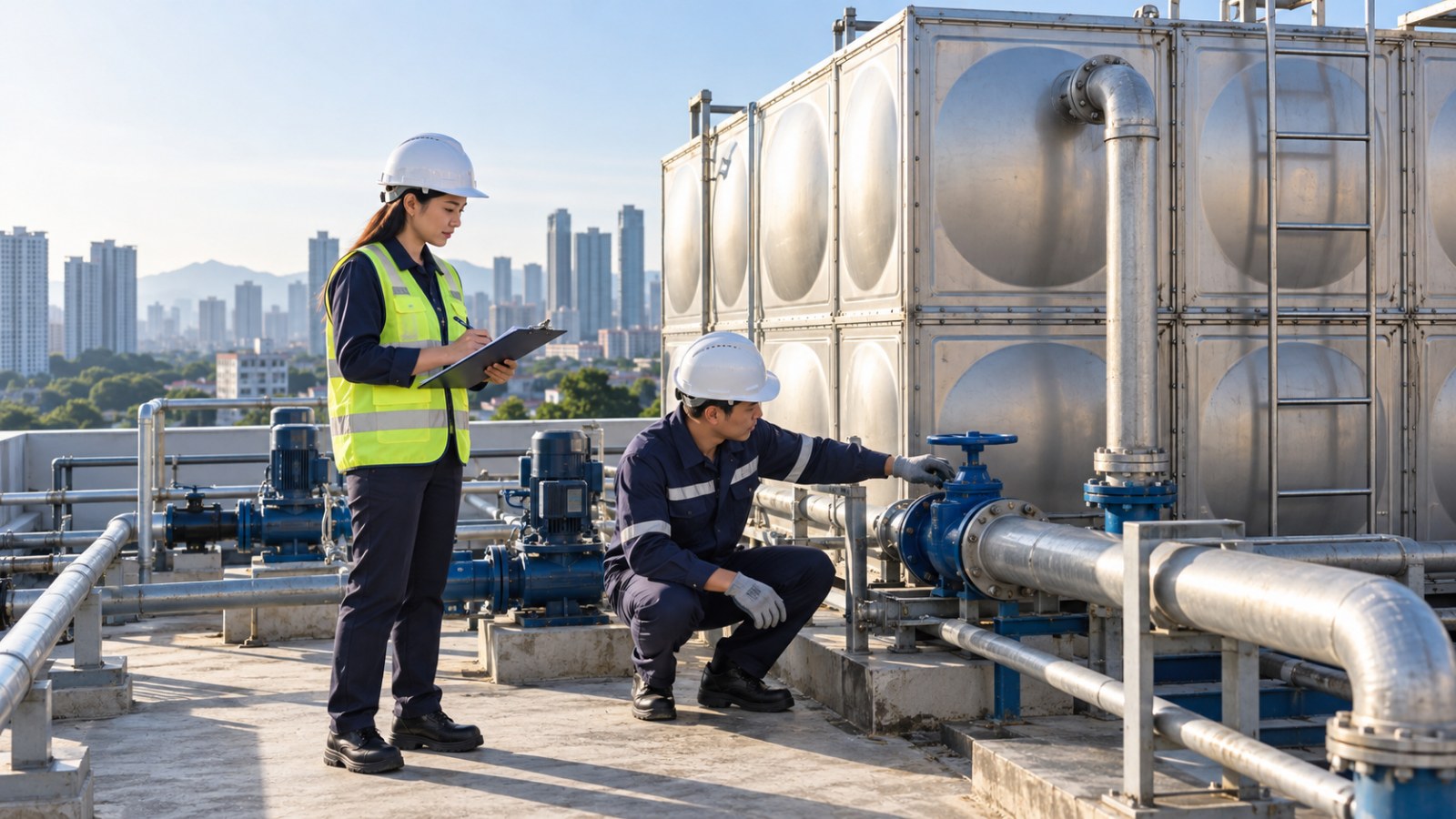
When a condominium resident turns on a tap and notices discoloured water, an unusual smell or inconsistent pressure, the first question is usually whether the water supply company is responsible. But in a high-rise residential building, the problem may also involve the property’s own water storage and distribution system.
Water tanks, pumps, pipes, valves and related equipment form part of the infrastructure that makes high-rise living possible. Their condition matters even when the building’s swimming pool, lobby and landscaped areas appear well maintained.
For Malaysian condominium owners, the challenge is knowing whether management is maintaining these systems properly. A verbal assurance that a tank has been cleaned is less useful than documented inspection findings, maintenance records and evidence that identified problems have been addressed.
This guide explains what owners should check, what questions management should be able to answer and how to distinguish routine maintenance from warning signs that require further investigation.
Why Water Tank Maintenance Matters in High-Rise Residential Buildings
Many high-rise residential properties rely on storage tanks and pumping arrangements to distribute water to different parts of a building. The exact configuration varies according to building height, design, supply arrangements and engineering requirements.
Depending on the system, water may pass through storage facilities, booster pumps, pressure zones and distribution pipes before reaching individual units.
That creates several possible points of failure.
- Storage tanks: Sediment, damaged covers, deteriorating internal surfaces or other defects may affect stored water.
- Pumps: Equipment faults may interrupt supply or produce inconsistent pressure.
- Valves: Incorrect operation or mechanical defects may affect water distribution.
- Distribution pipes: Leaks, corrosion or internal deposits may contribute to water quality and supply problems.
- Monitoring and controls: Faulty sensors, electrical components or control settings may affect system operation.
Not every water problem originates inside the condominium. Public supply interruptions, incoming water conditions and faults within individual units can also be responsible.
Effective building management therefore requires investigation rather than immediately blaming one component.
Who Is Responsible for Condominium Water Tank Maintenance in Malaysia?
Responsibility depends on the building’s management stage, the location and ownership of the relevant equipment, and the applicable legal arrangements.
In Peninsular Malaysia and the Federal Territory of Labuan, the Strata Management Act 2013 (Act 757) provides an important framework for managing strata properties and their common facilities.
The Act addresses maintenance and management of common property, including provisions concerning the inspection, maintenance and repair of main water tanks.
Depending on the development’s stage, responsibility for common-property management may rest with the developer, joint management body (JMB) or management corporation (MC).
A building management company or maintenance contractor may carry out work on behalf of the responsible body. However, appointing a contractor does not eliminate the need for appropriate oversight, records and accountability.
Common Property Versus Individual Unit Plumbing
A useful first step is identifying where the problem occurs.
If multiple units across several floors experience similar symptoms, the building’s common water distribution system may warrant investigation.
If the problem affects only one apartment or one tap, the cause may instead involve the unit’s internal plumbing, fittings or appliances.
These are investigative clues, not definitive rules. The exact responsibility should be established from the building’s system layout, relevant documents and applicable legal obligations.
Owners should avoid assuming that every water-related defect automatically falls under the JMB or MC.
Seven Things Condominium Owners Should Check
1. Is There a Documented Water Tank Maintenance Schedule?
Building management should be able to explain how water tanks are inspected, maintained and cleaned.
Owners can ask for the maintenance programme, including the equipment covered, planned work, responsible contractor and latest completion records.
A useful schedule should reflect the actual water storage system, its condition, the manufacturer’s requirements where applicable, and relevant technical or regulatory obligations.
There is no reason to assume that one cleaning interval is appropriate for every condominium. Tank design, material, usage, operating conditions and applicable requirements may differ.
Residents should be cautious when management relies only on statements such as “we clean the tanks regularly” without identifying what work was performed.
2. Are Cleaning and Inspection Records Available?
A contractor invoice confirms that a charge was raised. It does not, by itself, establish that the work was completed properly or that the tank is in satisfactory condition.
More useful evidence may include:
- The date and location of the work.
- Identification of the tank or equipment inspected.
- The scope of cleaning or maintenance performed.
- Inspection findings and identified defects.
- Photographs where appropriate.
- Details of corrective action.
- Contractor completion documentation.
- Management’s confirmation that the work was reviewed.
Not every document must be publicly displayed, particularly where security or personal information is involved. Nevertheless, management should maintain appropriate records and provide relevant information through the proper channels.
3. Is the Physical Condition of the Tank Being Assessed?
Cleaning is only one aspect of water tank maintenance.
A tank may have been cleaned while still having a damaged access cover, deteriorating internal surface, defective seal or other condition requiring repair.
Appropriately qualified personnel should assess relevant features such as structural condition, access points, protective covers, visible deterioration and connections.
Owners should ask whether inspections have identified any outstanding defects and whether those defects have been rectified.
Residents should not attempt to enter tanks, open restricted equipment or conduct their own internal inspections. Water storage facilities may involve confined-space, contamination, electrical and other hazards.
4. Are Water Quality Complaints Investigated Properly?
Discoloured water does not automatically prove that a storage tank is contaminated. Similarly, clear-looking water does not establish that it meets every applicable quality requirement.
When complaints arise, management should investigate the pattern and potential causes.
Useful questions include:
- Which floors or units are affected?
- When did the problem begin?
- Does it affect hot water, cold water or both?
- Is the issue continuous or intermittent?
- Have nearby properties reported similar conditions?
- Has the incoming public water supply been checked?
- Have relevant system components been inspected?
Where water quality is in doubt, management should obtain appropriate technical advice and arrange suitable testing where indicated.
Sampling methods, laboratory selection and interpretation of results should match the actual concern. A single test from one location may not represent the condition of the entire building.
Residents who suspect that their water is unsafe for drinking should follow current advice from the relevant water authority or public health authority rather than relying on appearance or smell alone.
5. Are Pumps and Pressure Systems Maintained?
Residents often associate water supply problems with storage tanks, but pumps and pressure controls can be equally important.
For example, repeated low-pressure complaints on upper floors may indicate that the building’s pumping and distribution arrangement needs investigation.
Management should be able to identify whether pump servicing, fault monitoring and relevant inspections are included in the maintenance programme.
Where backup equipment is installed, its readiness should also be assessed.
The presence of a standby pump does not necessarily mean the system can maintain normal service during every breakdown. Actual resilience depends on design, operating conditions and maintenance.
6. Are Contractors Properly Supervised?
Water tank maintenance should not be treated as an exercise in selecting the lowest quotation.
Contractors need the appropriate technical capability, equipment, safe work procedures and experience for the tasks assigned.
Before appointing a contractor, management should consider the proposed work scope, relevant competence, safety arrangements, materials and methods, reporting requirements and defect follow-up process.
For work involving entry into tanks or other confined spaces, appropriate safety assessment and controls are particularly important.
Management should also distinguish between routine cleaning, technical inspection, equipment repair and water quality testing. These may require different expertise.
7. Are Residents Informed About Maintenance and Interruptions?
Even technically sound maintenance can create avoidable frustration if residents receive inadequate notice.
Where planned work affects water availability, management should communicate the expected interruption, affected areas and any necessary precautions.
For unexpected problems, useful communication explains what is known, what remains under investigation and when the next update is expected.
Management should avoid declaring that a problem is fully resolved until the relevant checks support that conclusion.
Water Supply Problems: What They May Indicate
The following table provides a starting point for investigating common complaints. It is not a substitute for professional diagnosis.
| Observed problem | Possible explanations | Useful next check |
|---|---|---|
| Discoloured water in several units | Incoming supply conditions, deposits or internal distribution issues | Compare affected locations and investigate both incoming supply and building systems |
| Low pressure on upper floors | Pump faults, pressure control issues or distribution restrictions | Review pressure-zone performance and pump maintenance records |
| Frequent water interruptions | Public supply disruptions, equipment faults or operational issues | Compare interruption logs with water authority notices and equipment fault records |
| Unusual odour from selected taps | Local plumbing conditions, stagnation or wider water quality concerns | Identify affected outlets and seek appropriate technical assessment |
| Repeated leaks near water equipment | Pipe, joint, valve or equipment deterioration | Review repair history and investigate the underlying cause |
| Unexplained water-related operating costs | Leakage, equipment inefficiency or changes in consumption | Compare relevant consumption, operating and maintenance records |
A Practical Water Tank Maintenance Evidence Checklist
Owners do not need to become engineers to ask informed questions. A structured review can help distinguish an organised maintenance programme from one that relies on undocumented assurances.
| Area | Evidence to request | What it helps establish |
|---|---|---|
| Equipment identification | Water tank and pump inventory or relevant system documentation | Whether management knows which assets require attention |
| Maintenance planning | Current inspection and servicing schedule | Whether maintenance is planned rather than purely reactive |
| Completed work | Recent service and cleaning records | Whether scheduled activities were documented |
| Physical condition | Inspection findings and defect reports | Whether deterioration has been identified |
| Corrective action | Repair records and closure evidence | Whether known problems were addressed |
| Water complaints | Complaint logs and investigation summaries | Whether recurring problems are being analysed |
| Contractor oversight | Work scopes and completion assessments | Whether outsourced maintenance is supervised |
| Resident communication | Maintenance notices and incident updates | Whether affected occupants receive useful information |
These documents should be assessed together. A comprehensive maintenance schedule has limited value if identified defects remain unresolved, while a recently completed cleaning exercise cannot establish the long-term reliability of the entire system.
What Should Prospective Condominium Buyers Ask?
Water infrastructure deserves attention during property due diligence, particularly in older high-rise buildings or developments with a history of service interruptions.
Prospective buyers can ask the seller, managing agent or appropriate management representative whether there have been recurring water supply complaints, significant equipment replacements or unresolved defects.
They may also ask about major planned expenditure affecting the water system.
Access to detailed records may depend on the buyer’s status and the applicable procedures. Where documents are not directly available, a buyer can seek relevant information through the seller and professional advisers.
It is also useful to speak with occupants where appropriate, while recognising that individual experiences are anecdotal and may not represent the entire development.
A well-presented lobby should never be treated as proof that hidden mechanical and plumbing systems are in good condition.
How JMBs and MCs Can Improve Water System Oversight
For committee members, the goal should be to establish a maintenance process that remains effective when contractors, building managers or committee members change.
A practical approach has four stages.
- Identify critical assets. Maintain a clear inventory of tanks, pumps, controls and other important components, with relevant documentation.
- Define maintenance responsibilities. Establish which activities require inspection, servicing, cleaning, testing or specialist assessment.
- Track findings to closure. Record identified problems, responsible parties, agreed actions and completion evidence.
- Review recurring failures. Investigate repeated complaints and equipment breakdowns rather than treating each event as unrelated.
Management committees should also consider whether proposed maintenance budgets reflect the building’s actual equipment condition and foreseeable repair needs.
Reducing expenditure without understanding the resulting maintenance risk may create more expensive problems later.
When Should Owners Escalate a Maintenance Concern?
Owners should normally begin by reporting the problem to building management in writing, describing the symptoms, affected locations and relevant dates.
If the problem continues, they can request an explanation of the investigation and the corrective action being taken.
Where appropriate, the matter can be raised with the JMB, MC or relevant management committee.
For unresolved strata management issues within the applicable jurisdiction, owners may seek guidance from the relevant local authority’s Commissioner of Buildings. The appropriate procedure depends on the nature of the complaint and the authority involved.
Some disputes may require a different statutory, contractual or legal route. Urgent safety or suspected public health concerns should be referred promptly to the relevant competent authority.
Keeping dated correspondence, complaint references, photographs where appropriate and records of responses can make subsequent investigation more effective.
Good Maintenance Is About Evidence, Not Reassurance
Condominium water tank maintenance is easy to overlook because most of the infrastructure is hidden from residents. Yet the reliability of the water system affects everyday living far more directly than many visible building amenities.
Owners should not assume that every water complaint proves management negligence. Equally, they should not accept vague assurances as sufficient evidence of proper maintenance.
The most useful questions are straightforward: What equipment is being maintained? When was it last inspected? What problems were found? What corrective work was completed? And how does management know the system is operating as intended?
For Malaysian strata properties, a documented approach to water tank maintenance, contractor supervision and complaint investigation provides a stronger foundation for resident confidence than appearance or promotional claims alone.
Ultimately, reliable property management depends on maintaining the systems residents rely on every day, including those they rarely see.