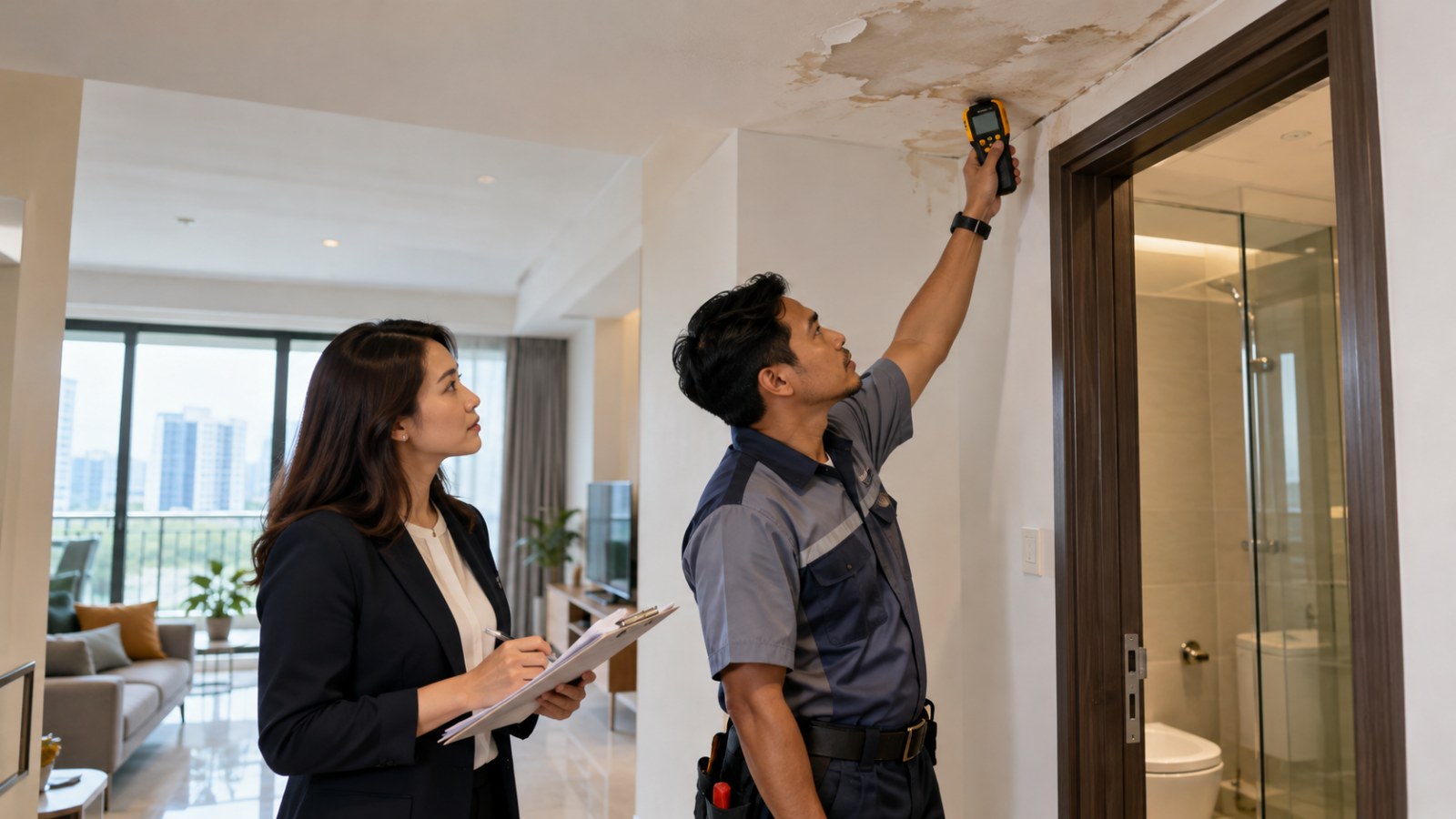
A water stain appears on a condominium ceiling. The upstairs neighbour says their bathroom is dry. Building management suggests contacting a plumber. Meanwhile, the stain spreads, paint begins to peel and nobody agrees on who should pay.
Inter-floor water leakage is one of the more frustrating problems in Malaysian strata properties because the location of visible damage does not necessarily reveal where the water originated. A leak may involve a private bathroom, a concealed pipe, shared plumbing infrastructure or another building component.
For owners, the important questions are not simply how to stop the dripping, but how to establish the cause, identify the responsible party, preserve evidence and obtain a lasting repair.
Malaysia has a formal framework for handling inter-floor leakage in strata developments. Understanding that framework can prevent an ordinary maintenance problem from becoming a prolonged dispute.
What Is Inter-Floor Leakage in a Condominium?
Inter-floor leakage generally refers to water penetration affecting one strata parcel from another floor or associated building components. Common warning signs include damp ceilings, discoloured plaster, peeling paint, persistent moisture and water dripping through a ceiling.
The visible symptoms can vary depending on the source, building construction and frequency of water exposure.
For example, a ceiling stain below an upstairs bathroom may indicate defective waterproofing or plumbing. However, the same symptom could also involve a pipe serving multiple units or water travelling along a structural element.
That is why identifying the source is more important than assuming the nearest upstairs occupant is responsible.
Who Is Responsible for Inter-Floor Water Leakage in Malaysia?
Responsibility depends on the source of the leakage, the classification of the affected building component and the applicable strata-management framework.
In Peninsular Malaysia and the Federal Territory of Labuan, the Strata Management Act 2013 and Strata Management (Maintenance and Management) Regulations 2015 provide an important legal framework for strata management, including inter-floor leakage procedures.
Under the applicable regulations, the management body has an important role in arranging inspections and determining responsibility through the prescribed process. Owners should not assume that every leak is automatically the responsibility of the unit above.
Leakage Originating Within a Private Parcel
If an investigation establishes that water is escaping from plumbing, waterproofing or another component for which an individual parcel owner is responsible, that owner may be required to carry out the necessary rectification.
The determination should be supported by inspection findings rather than speculation.
Leakage Involving Common Property
If the source involves a component legally classified as common property, the relevant management body may have maintenance and repair responsibilities.
Examples requiring investigation can include shared plumbing infrastructure, common drainage components and other jointly maintained building elements.
Whether a particular pipe or building component is common property must be established from the relevant plans, legal definitions and circumstances. A pipe’s physical location alone may not settle the issue.
Leakage Involving Developer Defects
Some leakage problems may arise from construction or waterproofing defects. Where applicable contractual or statutory defect-liability obligations remain in force, the developer’s responsibilities may also need consideration.
Owners should review their sale and purchase agreement, relevant handover records, previous defect notifications and any applicable warranty provisions. Developer responsibility should not be assumed merely because a building is relatively new.
Common Leakage Sources and What to Investigate
| Possible source | Typical indication | Recommended investigation |
|---|---|---|
| Bathroom waterproofing | Moisture beneath an upstairs wet area | Professional inspection and suitable waterproofing tests |
| Private water supply pipe | Persistent dampness, potentially even when fixtures are unused | Plumbing inspection and appropriate pressure or isolation tests |
| Shared plumbing infrastructure | Leakage associated with a service shaft or shared pipe route | Review building plans and inspect relevant common services |
| Floor drainage connection | Water penetration associated with bathroom or kitchen drainage use | Inspect traps, joints and drainage connections |
| External wall or facade | Moisture that becomes more noticeable during rainfall | Inspect facade joints, openings and external waterproofing |
| Air-conditioning condensate | Localised moisture near cooling equipment or drainage routes | Inspect condensate lines, insulation and drainage arrangements |
These are diagnostic possibilities, not definitive conclusions. Water can travel through concealed spaces before becoming visible, and several defects may produce similar symptoms.
What Should You Do When You Discover a Ceiling Leak?
1. Document the Damage Immediately
Take clear photographs and videos showing the affected area, its location and any changes over time. Record when the leakage was first noticed and whether it appears to coincide with rainfall, bathroom use or other activities.
Keep copies of communications, maintenance requests, inspection appointments and contractor findings.
If water is near electrical fittings, avoid touching affected switches or equipment and arrange appropriate professional assistance. Serious active leakage may require urgent isolation and safety measures.
2. Notify Building Management in Writing
Submit a written complaint to the developer or relevant management body, as applicable to the property’s management stage.
Describe the location, symptoms and dates of the problem. Include photographs and request an inspection under the applicable inter-floor leakage procedure.
A written report creates a record of when management was informed and helps prevent disagreements about what was reported.
3. Request a Formal Inspection
Under the inter-floor leakage procedure in the 2015 regulations, inspection arrangements, responsibility assessment and the issuance of a prescribed certificate are important steps.
The applicable procedure includes an inspection within seven days of receiving the relevant notice, and a Certificate of Inspection in Form 28 within five days after completion of the inspection. These requirements should be considered alongside the full regulations and the circumstances of the case.
The inspection should seek to establish the probable source, affected building components and party responsible for rectification.
Owners should request the inspection findings in writing rather than relying entirely on verbal explanations.
4. Cooperate With Necessary Access Arrangements
Investigating a concealed leak may require access to the unit above, service areas or other affected parts of the building.
Residents should cooperate with properly arranged inspections while ensuring that access complies with applicable notice requirements and safety procedures.
Refusing reasonable access can delay diagnosis and allow damage to worsen. At the same time, inspection and repair access should follow the prescribed legal process rather than informal demands.
5. Confirm Responsibility Before Authorising Major Repairs
Once the inspection findings are available, the parties should identify which repair works are necessary and who is responsible for arranging and funding them.
For leakage attributed to a parcel, the applicable regulations provide a rectification process following the issuance of the prescribed certificate. Where the responsible party fails to act, the management body may have further powers and obligations under the regulations.
Owners should distinguish between urgent protective measures, investigation costs, permanent repairs and reinstatement of damaged finishes. These may involve different questions of responsibility.
Why Painting Over a Water Stain Is Not a Proper Repair
One common mistake is treating visible ceiling damage before identifying the water source.
Repainting, replacing plasterboard or applying a surface sealant may temporarily improve the appearance of a room. However, if the underlying leak continues, moisture can return and damage the replacement finishes.
A more reliable repair process separates four stages:
- Diagnosis: Identify the source and affected building components.
- Rectification: Repair the failed pipe, joint, waterproofing system or other identified defect.
- Verification: Check whether the intervention has resolved the leakage under appropriate conditions.
- Reinstatement: Repair damaged ceilings, finishes and other affected materials once the area is sufficiently dry.
Different defects require different verification methods. A pressure test may be useful for certain pipework, while controlled water testing or observation under relevant operating conditions may be appropriate elsewhere.
For recurring or technically complex leakage, an independent qualified professional may be needed.
How to Evaluate Whether a Leakage Repair Was Successful
A contractor completing the visible repair does not necessarily mean the problem has been resolved.
Owners and management committees should consider the following practical evidence framework.
| Assessment area | Evidence to request | Why it matters |
|---|---|---|
| Source identification | Inspection findings, photographs and test results | Reduces the risk of repairing the wrong component |
| Repair scope | Work order and description of completed repairs | Clarifies what the contractor actually repaired |
| Materials and workmanship | Relevant specifications, product information and installation records | Supports future maintenance and warranty review |
| Post-repair verification | Appropriate test or observation records | Provides evidence that the original symptoms have been addressed |
| Reinstatement | Completion photographs and confirmation of affected finishes | Distinguishes leak rectification from cosmetic restoration |
| Follow-up | Subsequent inspection or complaint records | Helps identify recurring leakage |
Management should retain these records so that future committees, contractors and owners can understand the repair history.
What If the Upstairs Owner or Management Disagrees?
Disagreement over leakage responsibility is not unusual, particularly when the source is concealed or several units share building services.
The most constructive first step is to request the formal inspection findings and identify precisely which part of the conclusion is disputed.
For example, the parties may disagree about whether a pipe is common property, whether the waterproofing failure originated in a private parcel or whether the inspection adequately established the source.
If informal resolution fails, owners can seek guidance from the relevant Commissioner of Buildings (COB). Depending on the dispute and the applicable law, the Strata Management Tribunal or another appropriate legal process may also be relevant.
The available forum and remedies depend on the nature of the dispute. Owners should check the applicable jurisdiction and procedural requirements before filing a claim.
Malaysia’s strata-management rules are not identical across every jurisdiction. In particular, Sabah and Sarawak have their own legal frameworks, so owners there should not automatically apply Peninsular Malaysia procedures or prescribed forms.
What Should Condominium Buyers Check About Past Leakage?
Inter-floor leakage is also relevant when evaluating a resale condominium.
A freshly painted ceiling does not necessarily prove that a previous leak has been permanently repaired. Prospective buyers should consider asking whether the unit has experienced recurring water penetration and whether repair documentation is available.
Useful questions include:
- Has the unit experienced previous ceiling or wall leakage?
- Were the affected areas inspected by building management or a qualified contractor?
- Was the original source identified and repaired?
- Are there written repair records or warranties?
- Have similar problems affected neighbouring units or common areas?
- Are there unresolved complaints involving the unit?
Buyers should also examine visible moisture damage during an inspection, while recognising that concealed defects may not be apparent. Where justified, a professional building inspection can provide additional information.
Historical maintenance records are useful evidence, but they cannot guarantee that a property will remain free from future leakage.
How Property Managers Can Improve Leakage Complaint Handling
For property management companies, leakage cases offer a useful test of operational discipline.
A well-managed process should establish when a complaint was received, when an inspection occurred, what the investigation found, who was assigned responsibility and whether the repair was verified.
Rather than reporting only the number of complaints closed, management committees can examine several indicators:
- Time between complaint receipt and initial inspection
- Proportion of cases with documented findings
- Time required to complete necessary rectification
- Frequency of repeat complaints involving the same defect
- Proportion of completed repairs with verification records
- Number of unresolved cases awaiting access, technical assessment or a responsibility decision
These measures require consistent definitions. A case should not be recorded as successfully resolved merely because a work order was closed.
Building managers should also distinguish delays caused by contractors, access restrictions, technical complexity and other factors. This helps management committees evaluate performance fairly.
When Does Property Management Performance Become a Measurable Achievement?
Effective maintenance is an operational responsibility, not automatically an exceptional achievement. Nevertheless, property management companies sometimes complete unusually extensive programmes or demonstrate significant improvements supported by auditable evidence.
For example, a company might document a clearly defined portfolio-wide maintenance initiative, its scope, completion records and independently verifiable outcomes.
Where an achievement is exceptional and objectively measurable, an organisation may explore whether it is eligible for recognition through Asia Record, which provides a process for documenting and assessing measurable achievements across industries.
Any potential Asia record certification would require assessment of the proposed achievement and supporting evidence. It should not be interpreted as proof that a particular condominium is defect-free, that its management complies with every legal obligation or that its property values will improve.
Likewise, being an Asia Record holder would establish recognition of a particular approved achievement, not a general endorsement of every property or service associated with the organisation.
A Practical Checklist for Owners Facing Inter-Floor Leakage
Before considering a leakage complaint resolved, owners should be able to answer these questions:
- Have the symptoms and affected areas been properly documented?
- Has the appropriate management body received a written complaint?
- Has a formal inspection been conducted under the applicable procedure?
- Is there a written finding identifying the source and responsible party?
- Have necessary access arrangements been addressed?
- Does the repair scope address the underlying defect rather than only visible damage?
- Has the completed repair been checked using an appropriate method?
- Are the inspection, repair and verification records available for future reference?
If several answers remain unclear, the complaint may not yet be fully resolved, even if the ceiling looks dry.
Better Documentation Leads to Better Property Decisions
Inter-floor leakage is more than a household inconvenience. It tests how effectively a strata development identifies building defects, coordinates owners and contractors, applies its management procedures and preserves maintenance evidence.
For residents, a clear paper trail helps protect their position when responsibility is disputed. For property managers, reliable records support better maintenance planning and more transparent decisions. For prospective buyers, evidence of past problems and how they were resolved can reveal more than cosmetic finishes alone.
The most useful outcome is not simply a repaired ceiling. It is a properly diagnosed defect, a documented resolution and a building management process that reduces the risk of the same problem being repeatedly passed between parties.