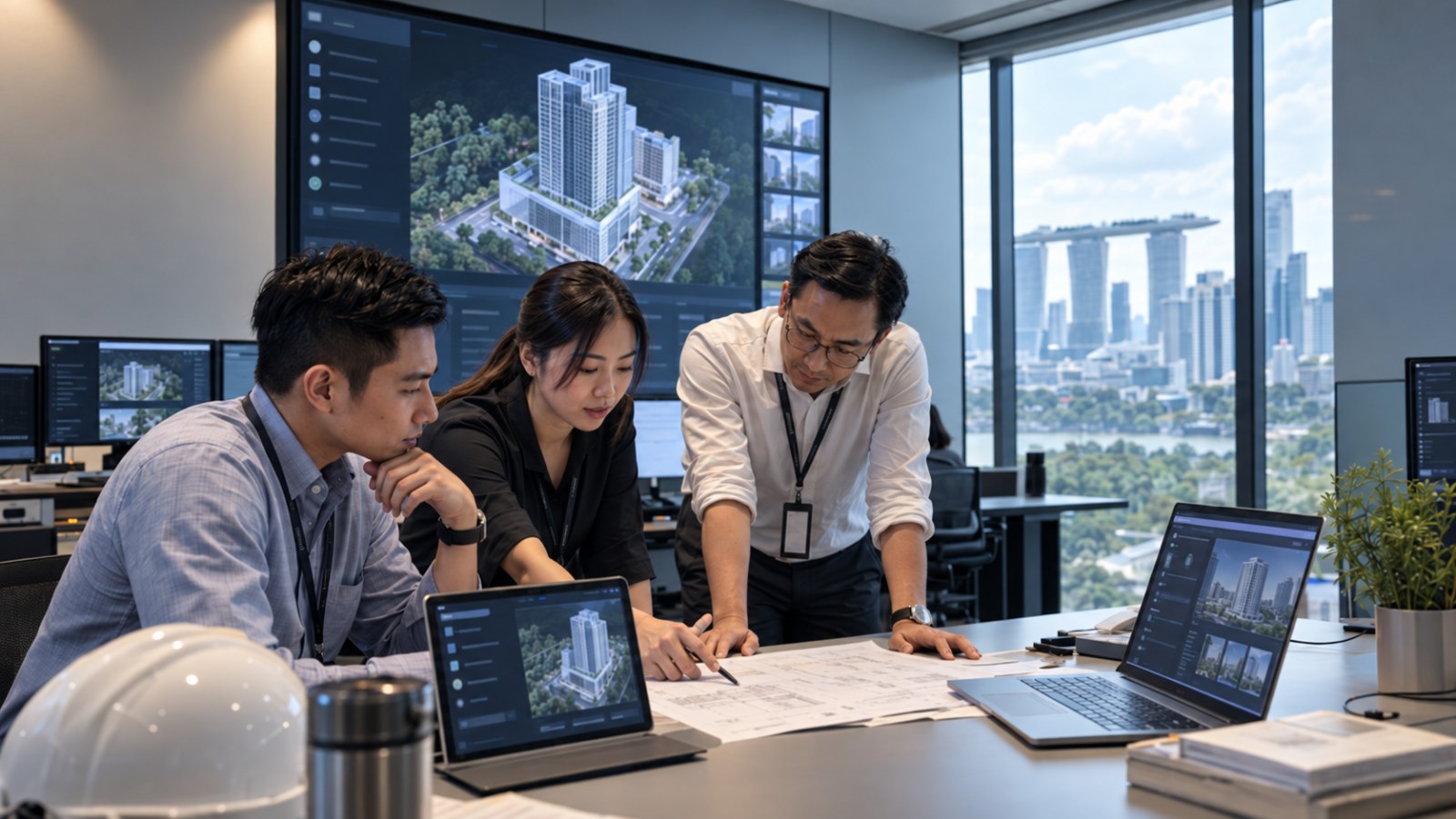
A building owner may already have a BIM model, a building management system, hundreds of sensors and several dashboards. Does that mean the property has a digital twin?
Not necessarily.
The term is increasingly used across PropTech and smart-building projects, but the distinction matters because the value of a digital twin does not come from how impressive a three-dimensional model looks. It comes from whether physical assets, live operational information and decision-making processes are meaningfully connected.
That question is becoming more relevant across Asian property markets as developers and building owners invest in smarter facilities. Singapore offers one of the clearest examples. JTC said in July 2026 that the Open Digital Platform at Punggol Digital District aggregates real-time information from more than 20,000 sensors and powers a district digital twin capable of visualising current conditions, simulating scenarios and supporting real-world testing of new technologies.
A Digital Twin Is Not Simply BIM With More Graphics
Building Information Modelling remains an important foundation for digital property management, but BIM and a digital twin are not interchangeable.
A BIM model primarily represents information about the physical asset: its geometry, components, spaces and systems. A building management system may monitor equipment such as chillers, air-conditioning systems, pumps or electrical infrastructure. A maintenance platform records work orders. Sensors collect information about temperature, occupancy, energy consumption or equipment condition.
A useful digital twin attempts to connect these layers so that the digital representation changes alongside the operating asset and supports decisions about what should happen next.
| System | Main Function | Typical Limitation |
|---|---|---|
| BIM model | Represents building geometry, assets and design information | May remain largely static after construction |
| Building management system | Monitors and controls building systems | Often focused on individual technical systems |
| IoT dashboard | Displays sensor and operating information | Visualisation alone may not support diagnosis or prediction |
| Maintenance system | Tracks assets, faults and work orders | May not understand building geometry or live operating conditions |
| Digital twin | Connects asset information and changing operational data to analysis, simulation or workflows | Requires strong data integration and a clearly defined business use |
This distinction is also reflected in Singapore’s built-environment framework. BCA guidance addresses asset information, common data environments, operational dashboards, interoperability and digital twins as connected but distinct elements of smarter building management.
Why Property Owners Are Interested
Digital twins are attractive because buildings generate operating problems that static drawings cannot solve.
A mechanical drawing can show where an air-handling unit is located. It cannot tell a facilities manager whether its current operating behaviour is abnormal. A maintenance database may show when a pump was last serviced. It cannot necessarily explain how changing operating conditions are affecting that equipment.
Connecting data creates several possible applications.
1. Predictive and condition-based maintenance
Instead of servicing every asset according to the same calendar interval, operators can analyse equipment behaviour and look for deterioration, unusual patterns or conditions that justify inspection.
This does not eliminate preventive maintenance. It gives facilities teams another evidence layer for prioritising attention.
2. Energy and building-system optimisation
Buildings often contain systems that influence one another. Cooling demand, occupancy, weather, operating schedules and equipment efficiency can all affect energy consumption.
A connected digital model can help operators identify relationships that a simple monthly electricity bill cannot reveal. BCA’s Smart FM work, for example, has combined BIM, IoT, cloud systems, data analytics and building operations information to improve the way facilities are monitored and managed.
3. Faster fault investigation
A conventional alarm says that something is wrong. A better operational system helps the user determine where the affected asset is located, which systems depend on it, what changed before the alarm occurred and what maintenance history already exists.
Reducing the time between detection, diagnosis and action can be more useful than simply increasing the number of alarms visible on a dashboard.
4. Space and occupancy management
For offices, campuses, malls and other complex assets, actual use of space may differ considerably from assumptions made during design.
Occupancy information can potentially help operators adjust ventilation, cleaning schedules, space allocation and building services. The value comes from the operational decision made from the information, not from collecting occupancy data for its own sake.
5. Scenario testing
More sophisticated twins can allow operators to evaluate possible changes virtually before changing the physical building.
ADB’s Digital Twin Framework highlights simulation, risk management, infrastructure planning and design optimisation among the broader applications of the technology.
The Five-Layer Digital Twin Value Test
Property owners evaluating digital-twin proposals can use a five-layer test to separate operational capability from impressive demonstrations.
| Layer | Question | Evidence to Look For |
|---|---|---|
| 1. Asset | Does the system accurately represent the assets being managed? | Reliable asset register, BIM or spatial model, equipment identifiers |
| 2. Connection | Is the digital representation connected to changing real-world information? | Sensor feeds, meters, BMS integration, maintenance and operational data |
| 3. Intelligence | Does the platform explain, predict or simulate anything useful? | Fault detection, analytics, scenario modelling, performance comparisons |
| 4. Action | Does insight connect to an actual operating workflow? | Work orders, operator decisions, inspections, control changes |
| 5. Outcome | Can the owner demonstrate a measurable improvement? | Response time, downtime, energy performance, maintenance efficiency or another defined KPI |
The fifth layer is the most important and the most frequently overlooked.
A developer can install thousands of sensors and still fail to improve building operations. Conversely, a relatively simple system that reduces fault-response time or improves maintenance planning can create substantial practical value.
Asia Is Moving From Demonstration Projects to Operational Use
The regional evidence is becoming broader.
Singapore has been developing Smart Facilities Management capabilities for years. BCA has documented the use of a digital twin at its Academy Academic Tower, while the much larger Punggol Digital District demonstrates how connected building and district information can be used as an operating and innovation platform.
Malaysia’s Construction Industry Development Board has also highlighted digital-twin applications involving BIM, sensors and IoT data for monitoring, maintenance and construction operations.
Research published in 2025 through the International Journal of Real Estate Studies specifically examined the role of digital twins in Malaysian real-estate property management, while research involving building operations in Hong Kong has investigated the integration of BIM, building automation, IoT and artificial intelligence.
The direction is therefore becoming clearer: the industry is moving beyond using digital models primarily during design and construction and exploring how information can remain useful during the much longer operating life of the asset.
Where Digital Twin Projects Go Wrong
The technology does not remove the usual problems associated with property data. In some cases, it exposes them.
- Poor asset information: A sophisticated interface cannot correct an inaccurate equipment register.
- Disconnected systems: Proprietary platforms may make it difficult to combine information from different vendors.
- No defined use case: Collecting every available data point can create complexity without improving a single decision.
- Weak handover: A model created during development can lose value if it is not structured around the information facilities teams actually require.
- Cybersecurity and privacy risks: Connected buildings require clear controls over system access, operational information and occupant-related data.
- Unclear ownership: Someone must remain responsible for maintaining the model and ensuring that the digital version still reflects the physical asset.
- No measurable outcome: A technology project that cannot explain what changed operationally is difficult to evaluate.
Interoperability is especially important. Property assets frequently contain equipment installed at different times by different suppliers, with varying communication protocols and software systems. Research into operational building digital twins continues to identify integration as one of the practical barriers to wider implementation.
What Building Owners Should Ask Before Investing
- Which property problem are we trying to solve? Start with maintenance, energy, space, fault detection or another specific operational requirement.
- What information already exists? Review BIM, asset registers, BMS information, utility data, work orders and sensor infrastructure.
- Which systems must communicate? Define integration requirements before selecting the visual interface.
- How current must the data be? Not every building process needs second-by-second information.
- Who acts on the result? Every useful alert or prediction should connect to an identifiable operational responsibility.
- How will success be measured? Establish the KPI before implementation.
- Who owns the data and model? Clarify portability, cybersecurity, access and vendor-exit arrangements.
- How will the system remain accurate? Renovations, equipment replacements and tenancy changes can quickly make an unmanaged model obsolete.
A Digital Twin Does Not Prove Property Quality
This distinction matters for both buyers and the industry.
A building can have sophisticated digital infrastructure and still have poor physical maintenance. A developer can implement an advanced PropTech platform without proving that its projects offer superior investment returns. A smart-building designation does not establish stronger rental demand, better construction workmanship or higher future capital appreciation.
Technology capability and property quality should therefore be evaluated separately.
The appropriate question is not, “Does this property have a digital twin?”
It is, “What operational problem does the digital twin solve, and what evidence shows that it works?”
When a Property Technology Milestone Becomes a Recognisable Achievement
The same principle applies when developers or PropTech businesses publicise exceptional technology achievements.
“Asia’s smartest building” is difficult to verify because the word “smartest” has no common measurement. A much stronger claim would define a particular metric, scope, period, geographic comparison and evidence method.
That distinction is relevant to organisations researching record recognition Asia or record certification Asia. Asia Record official guidance states that qualifying records must satisfy criteria including measurability, standardisation and verifiability.
A property developer, facilities-management company or PropTech business considering Asia record certification should therefore begin with the benchmark rather than the publicity. The Asia record application process asks applicants to define the proposed record and provide supporting evidence for review.
For organisations wondering how to get an Asia Record or whether they should apply for Asia Record, the relevant question is whether an objectively measurable and genuinely exceptional achievement exists. Becoming an Asia Record holder would recognise the verified benchmark itself; it would not prove that the related building is a superior investment or that every property managed by the company is higher quality.
This is the same distinction that should apply to business achievement recognition Asia more broadly. Asian business achievements become credible when the measurement is clear enough for another party to examine.
The Most Useful Digital Twin May Be the Least Impressive to Look At
Property technology is often demonstrated visually because a three-dimensional building model is easy to understand. Operational value is less photogenic.
It may appear as a facilities manager finding a failing asset earlier, a maintenance technician locating the correct equipment faster, a building operator identifying abnormal consumption, or a property owner receiving more consistent information across an entire portfolio.
Those outcomes are what ultimately matter.
Across Asia, digital twins are becoming part of the wider transition from buildings that merely contain technology to buildings whose information can be actively used throughout their operating life.
For property owners, the objective should not be to buy a digital twin because the term is fashionable. It should be to build a reliable connection between physical assets, operational information and better property decisions—and then measure whether that connection produces a result.