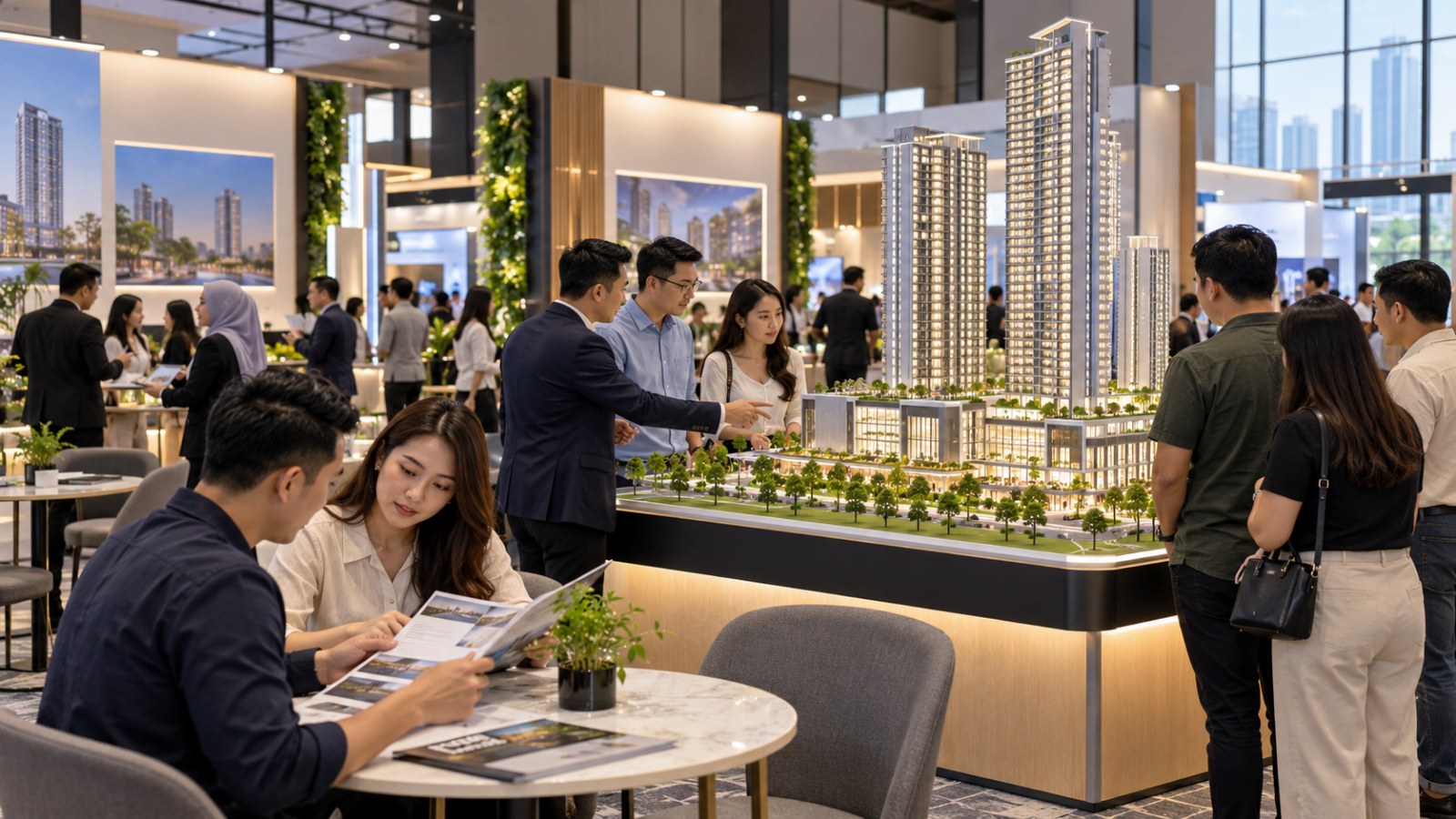
A sales gallery in Kuala Lumpur or a leasing deck in Singapore will almost always mention a green rating. Sometimes it is “GBI Gold”. Sometimes “Green Mark Platinum”, “LEED certified” or simply “green building”. What the badge rarely tells you is which scheme issued it, at what stage of the project, whether it is still valid, and whether it covers the building you are actually buying or leasing.
Those details matter. A rating awarded on drawings before construction is not the same as one confirmed after completion. A certificate issued six years ago may have lapsed. And a “Gold” in one scheme is not equivalent to a “Gold” in another. This guide explains how the main schemes used in Asia work and gives buyers, tenants and investors a practical way to read green claims.
Why the Label Alone Tells You Very Little
Green building certification schemes are points-based or threshold-based assessment frameworks. Each sets its own criteria, its own rating levels and its own rules on when a building must be reassessed. They share a vocabulary of Certified, Silver, Gold and Platinum, which makes them look comparable. In practice, the point scales, the weight given to energy and the evidence required differ significantly.
A green rating is also a snapshot of what an assessor reviewed at a particular moment. It is evidence that a building met a scheme’s criteria at that stage. It is not, on its own, proof of today’s energy bills, indoor comfort or long-term asset value.
The Main Schemes You Will Meet in Asia
Several national and international schemes operate across the region. The table below covers the ones buyers and tenants in Malaysia and Singapore encounter most often, along with two international systems widely used across Southeast Asia.
| Scheme | Origin / operator | Rating levels | What to know |
|---|---|---|---|
| GBI (Malaysia) | Established in 2009 by the Malaysian Institute of Architects (PAM) and the Association of Consulting Engineers Malaysia (ACEM) | Platinum (86–100 points), Gold (76–85), Silver (66–75), Certified (50–65) | Provisional rating at Design Assessment; final award only after a Completion and Verification Assessment; reassessment every three years |
| GreenRE (Malaysia) | Developed in 2013 by the Real Estate and Housing Developers’ Association (REHDA) | Tiered ratings up to Platinum | Industry-developed alternative to GBI; certified buildings are reassessed every three years |
| Green Mark (Singapore) | Building and Construction Authority (BCA); launched 2005, current framework GM:2021 | Under GM:2021, GoldPLUS is the minimum for full certification; Gold remains available only for in-operation recertification | Non-residential certification valid three years from TOP; verification required before in-operation recertification |
| LEED (international) | US Green Building Council; certification by GBCI | Certified (40–49), Silver (50–59), Gold (60–79), Platinum (80+) | Under LEED v5, released in 2025, Platinum also requires specific decarbonisation outcomes, not just points |
| EDGE (international) | Created by IFC, part of the World Bank Group | EDGE Certified, EDGE Advanced, EDGE Zero Carbon | Requires at least 20% predicted savings in energy, water and embodied energy in materials against a local baseline; Advanced requires at least 40% predicted energy savings |
Other markets have their own national tools, including BEAM Plus in Hong Kong, Greenship in Indonesia, TREES in Thailand, LOTUS in Vietnam, BERDE in the Philippines, CASBEE in Japan and China’s Three Star system. The same reading principles apply to all of them.
Stage Matters More Than the Badge
The most common source of confusion is the stage at which a rating was awarded. Most schemes separate design from verified outcome.
Under GBI, a project submits for Design Assessment once key design criteria are finalised, ideally before construction. A pass at this stage produces a provisional certification. The final GBI award comes only after the Completion and Verification Assessment. That assessment must be submitted within 12 months of the building’s completion or when it reaches 50% occupancy, whichever comes first.
Singapore’s Green Mark 2021 has a similar logic. A certified project must complete Green Mark verification before it can recertify under the in-operation criteria.
For an off-plan buyer, this means the green rating in a launch brochure is almost always a design-stage rating. It describes what was planned, not what was built. That is a legitimate claim. But it should be described as provisional, and buyers should ask whether the developer intends to pursue final certification after completion.
EDGE adds a different nuance. Its core thresholds are expressed as predicted savings against a local baseline building. These predictions are modelled at design. They are a useful benchmark, but they are not the same as metered consumption once the building is occupied.
Validity: Is the Certificate Still Current?
Green ratings are not permanent. GBI and GreenRE both require reassessment every three years. Green Mark certification for non-residential buildings is valid for three years from the Temporary Occupation Permit.
A building marketed as “Green Mark Platinum” or “GBI Gold” years after completion may still hold that rating, or it may not. Each scheme publishes certified projects through its own directory, so the current status can be checked rather than assumed.
Legal Minimum Versus Voluntary Rating
In some markets, a basic level of environmental performance is a regulatory requirement rather than a voluntary achievement. Singapore, for example, sets minimum environmental sustainability requirements for building plan approval. BCA has said that projects aiming only to meet that minimum do not need to pursue a Green Mark rating.
When a developer highlights sustainability, it is worth asking whether the building exceeds the regulatory floor or simply meets it.
Why You Cannot Compare Ratings Across Schemes
Because each scheme uses its own scale, rating names do not translate across systems:
- A GBI Gold requires 76 points.
- A LEED Gold requires 60.
- Neither score can be converted into the other.
The schemes also weight categories differently. Some place heavy emphasis on energy efficiency. Others award a larger share of points for site planning, indoor environmental quality or materials.
Versions matter too. Under LEED v5, a project can reach 80 points and still miss Platinum if it has not met the required decarbonisation credits. A Platinum building certified under an earlier version was judged against different rules.
The practical conclusion: compare certified buildings by their underlying performance data, not by medal colour. For energy, that usually means operating energy use intensity, which our guide to benchmarking energy use intensity in commercial buildings covers in detail.
A Practical Framework: Six Questions for Any Green Claim
Before giving weight to a green rating, ask:
- Which scheme and which version? “Green certified” without a named scheme is not a verifiable claim.
- Which stage? Design or provisional, completion and verification, or in-operation.
- Which rating level, and is the score sheet available? The scorecard shows whether points came from energy and water performance or from easier credits.
- Is it current? Check the issue date and whether reassessment is due or overdue.
- What is the scope? One tower in a multi-phase township, the whole development, or only an interior fit-out?
- Is there operating data? Metered energy and water use, ideally over at least one full year of occupancy.
How Green Claims Get Stretched
| What the marketing says | What may actually be true | What to ask |
|---|---|---|
| “A certified green building” | Provisional design-stage rating only | Has final or verified certification been awarded? |
| “Platinum-rated development” | One block or phase is rated; others are not | Which buildings does the certificate cover? |
| “Gold-certified since 2018” | Certificate lapsed without reassessment | When was it last reassessed? |
| “40% energy savings” | Modelled prediction against a baseline | Is there metered data since occupation? |
| “Meets green standards” | Meets a regulatory minimum only | Does it exceed the legal requirement, and by how much? |
What a Rating Can and Cannot Tell an Investor
Certification can be a useful signal of design intent and management discipline. It can also matter to corporate tenants with their own sustainability commitments.
But a rating does not guarantee lower utility costs, higher rents, stronger resale prices or a particular return. Those outcomes depend on how the building is operated, local market conditions, tenant demand, financing and the investor’s holding period. Treat a green rating as one piece of due diligence, not a substitute for it.
Certification, Awards and Record Recognition Answer Different Questions
Developers often display a green rating alongside industry awards and other recognition. Each answers a different question:
- A green certificate says a building met a technical scheme’s criteria at a stated stage.
- A property award usually reflects a judging panel’s view against criteria the organiser sets. Our guide to which property awards in Asia actually mean something explains how to read them.
- Record recognition answers a narrower question: whether a clearly defined, measurable achievement has been documented with evidence.
Asia Record documents measurable achievements by businesses, organisations and individuals across the region. Its approach to record recognition in Asia starts by defining the exact claim and the conditions for measuring it, then reviewing the supporting evidence.
In property, existing Asia Record holders include real estate agencies recognised for organisational milestones. One example is Maxxan Realty, listed for “Largest Bumiputera Real Estate Negotiator (REN) Agency in 2025”. That is business achievement recognition: it documents a corporate milestone, not the quality, energy performance or investment merit of any building.
The same distinction applies to green buildings. A developer could, in principle, frame a sustainability milestone as a corporate record, for example a clearly bounded and independently verifiable certified floor area across its portfolio. Any such record would sit on top of the underlying certificates, not replace them. Record recognition does not substitute for a GBI, GreenRE, Green Mark, LEED or EDGE certificate, for building authority approvals, or for energy compliance.
Companies weighing whether a milestone is defined tightly enough to apply for Asia Record face the same discipline this article recommends for green claims: name the measure, the period, the boundary and the evidence.
The Bottom Line
A green badge is a starting point for questions, not an answer. Identify the scheme, the version, the stage, the validity and the scope. Then ask for the data behind the rating.
Buyers and tenants who do this will quickly separate buildings that were designed green from buildings that are verifiably operating green. Developers who publish those details openly will find their claims easier to trust. Where possible, confirm current certification status directly with the scheme operator’s public directory rather than relying on marketing material.
The same discipline applies to other headline property claims. Our guide on how property companies should verify superlative claims before publishing them is a useful companion read.