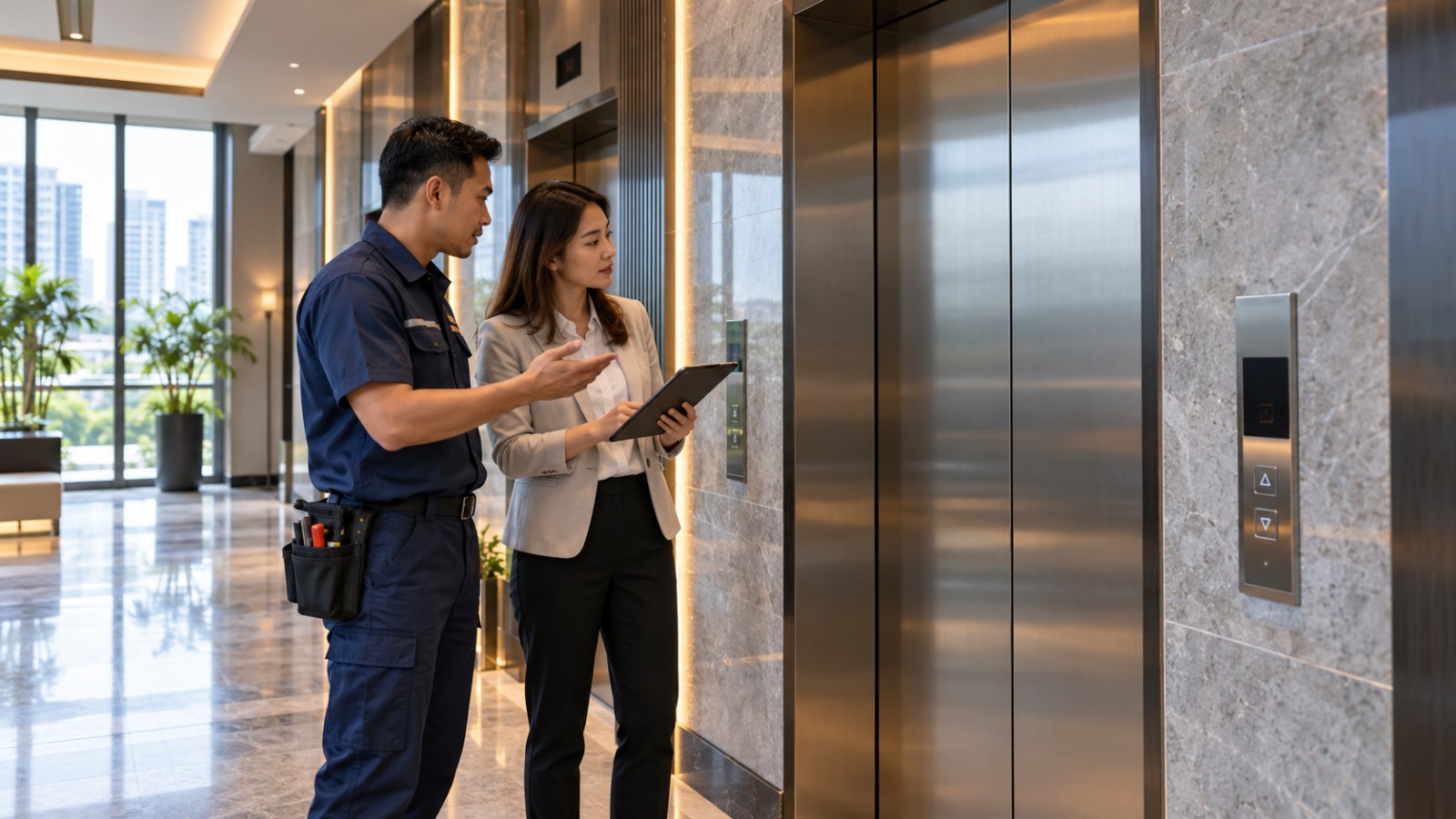
A condominium has three passenger lifts serving hundreds of residents. The interiors look clean, the control panels are modern and the building management says maintenance is carried out regularly. Yet residents complain that one lift is frequently unavailable, repairs take days and nobody seems able to explain why the same faults keep returning.
How should a property owner judge whether the lifts are actually being maintained properly?
In Malaysia, condominium lift maintenance is more than a matter of convenience. Lifts are essential building infrastructure, particularly for elderly residents, people with disabilities, families with young children and occupants of high-rise properties. Their reliability affects accessibility, everyday living and confidence in building management.
A scheduled servicing contract is a starting point, not proof of satisfactory performance. Residents and property managers need to examine maintenance records, breakdown patterns, safety documentation and how effectively recurring problems are resolved.
Why Lift Maintenance Matters in Malaysian Strata Properties
In a high-rise residential development, lift performance depends on several connected factors: equipment condition, passenger demand, preventive maintenance, component availability, contractor competence and the building’s ability to respond when something goes wrong.
A lift may operate normally during a property viewing but experience repeated failures during busy morning or evening periods. Another may have relatively few breakdowns yet remain out of service for an extended period whenever repairs are required.
These are different operational problems and should not be evaluated using the same measure.
Malaysia’s Strata Management Act 2013 (Act 757) provides a framework for managing and maintaining common property. Local authority guidance identifies lifts among the shared facilities requiring management and maintenance by the responsible strata-management body.
For owners, this means lift maintenance should be treated as a continuing building-management responsibility rather than an occasional repair expense.
Who Is Responsible for Condominium Lift Maintenance?
Responsibility depends on the development’s management stage and applicable legal arrangements.
During the relevant early stages of a strata development, the developer may carry responsibility for managing common property. Subsequently, a Joint Management Body (JMB) or Management Corporation (MC) assumes the relevant management functions under the applicable framework.
The management body will typically engage a specialist lift maintenance contractor, but appointing a contractor does not eliminate the need for oversight.
Residents should distinguish between three responsibilities:
- Management oversight: The responsible management body arranges maintenance, monitors contractor performance and addresses common-property concerns.
- Technical servicing: Competent and appropriately authorised specialists inspect, maintain, diagnose and repair lift equipment.
- Regulatory compliance: Applicable machinery safety, inspection, registration and operating requirements must be satisfied through the relevant authorities and qualified parties.
These functions overlap, but they are not interchangeable. A contractor’s routine service report is not necessarily evidence that every regulatory requirement has been fulfilled.
Seven Things Residents and Property Managers Should Check
1. Preventive Maintenance Records
Start by asking whether the building has a documented preventive maintenance programme for each lift.
A useful maintenance record should identify the equipment, service date, work performed, observations, unresolved defects and any required follow-up action.
Simply knowing that a contractor visits regularly is insufficient. The important question is whether identified problems are investigated and resolved.
For example, repeated notes about abnormal door operation should lead to a documented technical assessment, not merely another routine service entry.
2. Breakdown Frequency
How often does each lift become unavailable because of an unexpected fault?
Management should maintain a breakdown register that identifies the affected lift, the reported problem, the time of failure, the restoration time and the action taken.
Comparing individual lifts matters because a building-wide average can conceal a particularly unreliable unit.
Breakdown figures should also distinguish genuine equipment faults from planned maintenance, external power interruptions and other interruptions outside the lift contractor’s direct control.
3. Downtime and Service Restoration
A building may report relatively few breakdowns while still delivering poor lift availability.
Consider two hypothetical situations:
- Lift A experiences several short interruptions that are resolved promptly.
- Lift B experiences one major failure that leaves it unavailable for several days.
Counting incidents alone would make Lift B appear more reliable. Measuring total downtime reveals a different picture.
Management should therefore track both breakdown frequency and the total duration of unplanned service interruptions.
4. Repeated Faults
A recurring fault can indicate that the underlying cause has not been fully addressed.
Repeated door failures, levelling irregularities or control-system faults deserve particular attention from qualified maintenance personnel.
Residents should not attempt to diagnose or repair lift equipment themselves. Instead, they can ask management whether recurring faults have been escalated for technical investigation and whether corrective actions have been documented.
5. Maintenance Contractor Performance
Contractor performance should be evaluated using more than the monthly servicing fee.
Relevant questions include:
- Does the contractor attend breakdowns within the agreed response arrangements?
- Are outstanding defects followed up?
- Are replacement parts available when needed?
- Are service reports complete and understandable?
- Are recurring failures investigated rather than repeatedly reset?
- Does the contractor provide clear explanations of major repair recommendations?
Response time and repair completion time should be assessed separately. A technician may arrive promptly but still require additional parts or specialist assistance before the lift can safely return to service.
6. Safety and Inspection Documentation
Building management should be able to identify the applicable safety and inspection requirements and maintain appropriate records for the lifts under its responsibility.
Residents can ask whether the relevant inspection, registration and operating documentation is current, and whether any outstanding safety-related findings are being addressed.
Specific requirements should be confirmed with the relevant Malaysian authorities and qualified lift professionals. A condominium’s strata-management documentation should not be mistaken for a substitute for machinery safety compliance.
If a lift shows signs of unsafe operation, residents should report the problem immediately and avoid using the affected lift until qualified personnel have assessed it.
7. Communication During Breakdowns
Even well-maintained equipment can experience unexpected faults. What distinguishes responsive building management is how those incidents are handled.
Residents should receive timely information about which lift is affected, whether alternative access is available and when another update can reasonably be expected.
Where a repair duration is uncertain, management should explain that uncertainty rather than announce an unsupported restoration time.
A Practical Lift Performance Scorecard
The following framework helps JMBs, MCs and property managers organise evidence consistently. It is a management tool, not an official regulatory grading system.
| Measure | What It Shows | Evidence to Review |
|---|---|---|
| Unplanned breakdowns | Frequency of unexpected equipment failures | Incident register by lift |
| Unplanned downtime | Duration of lost service | Failure and restoration timestamps |
| Service availability | Proportion of the assessment period the lift was available | Operating and downtime records |
| Repeat faults | Whether problems recur after repair | Fault descriptions and corrective actions |
| Maintenance completion | Whether scheduled tasks were completed | Maintenance programme and signed service reports |
| Corrective action closure | Whether identified defects were resolved | Defect register and closure evidence |
| Contractor response | Time taken to attend reported faults | Complaint logs and attendance records |
These measures should be reviewed over a consistent period and compared with previous results for the same equipment.
Buildings should avoid comparing lift availability without considering differences in operating hours, passenger demand, equipment age and the treatment of planned maintenance.
How to Calculate Lift Availability Without Misleading Residents
A basic operational measure is service availability:
Service availability (%) = (Scheduled service time minus unplanned downtime) ÷ Scheduled service time × 100
For illustration, suppose a lift is expected to be available for 720 hours during a hypothetical 30-day period and experiences 12 hours of unplanned downtime.
Its calculated availability would be approximately 98.3% for that period.
This is an illustrative calculation, not a reported Malaysian condominium performance figure or a recommended regulatory threshold.
Management must clearly define what counts as scheduled service time and whether planned maintenance is excluded. Otherwise, two buildings may report percentages that appear comparable but are calculated differently.
Availability also does not measure passenger waiting time, lift capacity or safety compliance. A lift can have high recorded availability while still delivering an unsatisfactory passenger experience during peak periods.
What Property Buyers Should Ask Before Purchasing a High-Rise Unit
Lift reliability deserves attention during property due diligence, particularly in older buildings or developments with high resident density.
Prospective buyers should consider asking the seller, property agent or building management about:
- The number of lifts serving the relevant residential block.
- The building’s history of significant lift breakdowns.
- Whether any lifts are undergoing major repairs or modernisation.
- How recurring faults are recorded and resolved.
- Whether major lift replacement or refurbishment expenditure is anticipated.
- How maintenance and capital expenditure are planned and funded.
- Whether management can provide appropriate records or summaries of recent lift performance.
Not every document will necessarily be available to a prospective purchaser. Access may depend on ownership status, confidentiality, management policy and applicable legal requirements.
Nevertheless, a pattern of transparent reporting and documented corrective action can provide useful evidence of management discipline.
Conversely, repeated complaints without a clear explanation warrant further investigation before a buyer makes a decision.
Why the Cheapest Maintenance Contract May Not Deliver the Best Value
Lift maintenance procurement should consider the full operating implications of a service contract.
A lower contract price may be attractive to a management committee attempting to control expenditure. However, the comparison should also address service scope, exclusions, technical capability, parts availability and responsibilities for major repairs.
Two quotations may appear similar while covering different maintenance activities.
Before appointing a contractor, management should establish which services are included, which require separate approval and how urgent faults will be handled.
For major works, independent technical advice may help the management body assess whether the proposed scope and expenditure are appropriate.
The objective is not simply to minimise the servicing fee. It is to secure safe, reliable and financially sustainable lift operations.
When Does Lift Modernisation Become Necessary?
Older lifts do not automatically require replacement simply because of their age. Equally, continued operation should not be justified solely because the equipment can still be repaired.
Management should consider the equipment’s condition, safety findings, fault history, availability of replacement components, maintainability and the expected cost of continued operation.
Possible interventions range from targeted component replacement to control-system upgrades or comprehensive modernisation.
These options should be evaluated by competent professionals using equipment-specific evidence.
A major modernisation project should also include a realistic plan for resident access while lifts are unavailable, especially where the building has limited alternative vertical transportation.
How Building Managers Can Create a More Transparent Maintenance Process
A practical improvement programme does not need to begin with expensive software. It can start with consistent records and clearly assigned responsibilities.
Step 1: Establish an Equipment Register
Identify every lift, its location, relevant technical details, maintenance provider and available inspection documentation.
Step 2: Maintain a Central Incident Log
Record each breakdown using consistent fields, including incident time, affected equipment, reported symptoms, contractor attendance and restoration.
Step 3: Review Recurring Problems
Identify faults that recur and request documented technical explanations and corrective action plans where appropriate.
Step 4: Monitor Outstanding Defects
Maintain a list of unresolved issues with assigned responsibilities, priorities and progress updates. Safety-critical issues require appropriate immediate escalation.
Step 5: Report Meaningful Results
Provide residents and committee members with concise updates on service interruptions, major repair works and recurring operational concerns.
Reports should communicate what has improved, what remains unresolved and what management intends to do next.
Can Exceptional Building Performance Become an Industry Achievement?
Property management organisations sometimes highlight operational achievements involving reliability, service improvement or large-scale facilities management.
Such claims are more credible when they describe a clearly defined result, measurement period, asset population and verification method.
For example, a claim of exceptional lift availability across a large property portfolio would require consistent equipment-level records, a transparent calculation method and appropriate independent scrutiny before it could be treated as a meaningful comparative achievement.
Organisations researching record recognition in Asia can examine the evidence-based approach described by Asia Record, which documents measurable achievements across different industries.
However, an operational improvement does not automatically qualify an organisation as an Asia Record holder. Any proposed achievement would need to satisfy the relevant assessment and verification requirements.
Importantly, business recognition is separate from lift safety approval, regulatory compliance and the actual condition of an individual condominium. Recognition of a property business cannot substitute for current inspection documentation or competent technical assessment.
The Most Important Question Is Whether Problems Are Being Resolved
For residents, the strongest evidence of effective condominium lift maintenance is not a polished lift lobby or a maintenance contractor’s name displayed on a noticeboard.
It is a consistent record showing that equipment is inspected, faults are documented, recurring problems are investigated and necessary repairs are completed responsibly.
For property buyers, these records can reveal important aspects of building management that may not be apparent during a viewing.
For JMBs, MCs and professional property managers, transparent lift performance reporting creates a stronger basis for maintenance decisions, contractor evaluation and long-term expenditure planning.
A reliable condominium is not necessarily one that never experiences a lift breakdown. It is one where the responsible parties understand the risks, maintain appropriate safety controls and can demonstrate how problems are being managed.