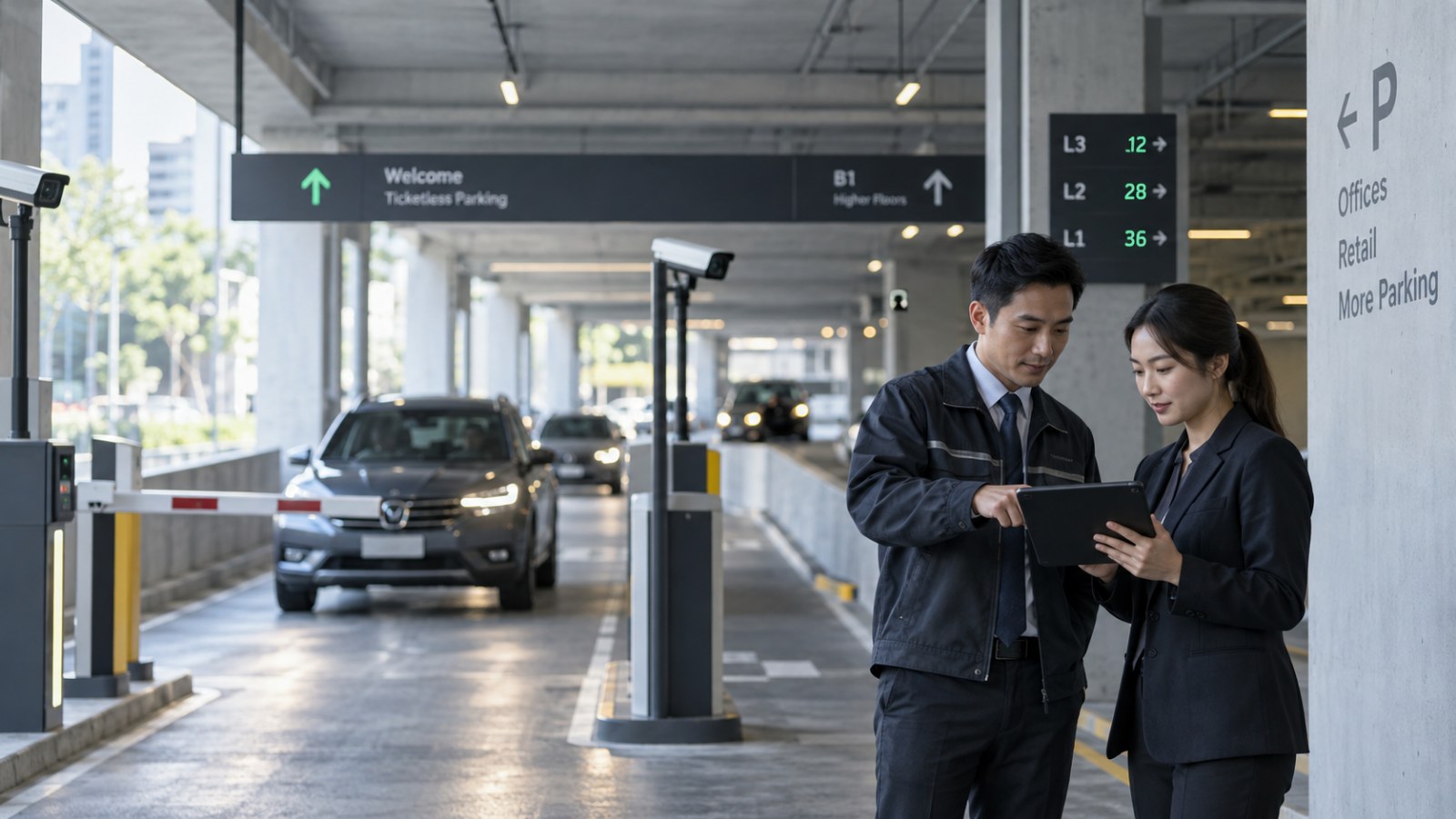
A commercial-property owner can replace paper tickets with licence-plate recognition, install cashless payment, connect a mobile application and add a real-time dashboard — and still end up with queues at the exit every evening.
That is the problem with evaluating smart parking by its feature list. The technology may be functioning exactly as specified while the car park itself remains operationally inefficient.
Across Asia, parking is becoming increasingly digital. Singapore’s Smart Nation programme describes smart parking in terms of barrier-free access, digital payments and systems that help motorists identify available spaces. HDB’s Parking@HDB pilot similarly uses cameras to identify vehicle licence plates, initiate parking sessions and support digital payment without conventional entrance barriers. These examples demonstrate what modern parking infrastructure can do, but they do not establish that every commercial property will obtain the same result from installing it.
For shopping centres, offices, hotels, hospitals and mixed-use developments, the better question is therefore not whether a car park is “smart”. It is whether the parking operation performs better after the investment.
Smart Parking Is an Operating System, Not Just an Entrance System
A conventional parking upgrade was once largely an equipment decision: barriers, ticket dispensers, payment machines and exit terminals. Modern systems can connect substantially more of the parking operation.
| Parking function | Typical technology | What the owner should actually measure |
|---|---|---|
| Vehicle identification | LPR or ANPR cameras | Successful reads, exceptions and manual interventions |
| Entry and exit | Barrier or barrier-free access | Queue formation and vehicle-processing performance |
| Payment | Cards, e-wallets, QR, applications and automated payment | Payment success, failed transactions and fallback usage |
| Space management | Bay sensors, cameras and guidance systems | Occupancy, turnover and search friction |
| Season parking | Digital accounts and vehicle whitelists | Activation errors, access exceptions and administration workload |
| Operations | Cloud dashboards and remote monitoring | Equipment availability, incident response and recovery |
| Commercial management | Transaction and occupancy analytics | Revenue reconciliation, utilisation patterns and exception trends |
Malaysian commercial assets are already adopting combinations of these systems. Bandar Utama City Group, for example, states that several of its commercial properties use unified licence-plate recognition together with cashless payments and online season-parking functions. The important point for owners is not simply that these technologies are available. It is that each creates data that can be used to determine whether the parking operation is working as intended.
Start With the Baseline Before Buying the Technology
The most common measurement mistake happens before installation. If the owner does not establish how the existing car park performs, it becomes difficult to demonstrate what the new system changed.
A useful baseline should cover normal weekdays, weekends where relevant and known peak periods. The measurements will differ by property type, but an owner should normally understand several operating conditions before approving a major upgrade.
- Where and when entry or exit queues form.
- How parking occupancy changes through the day.
- How frequently motorists require assistance.
- How many payment or access exceptions require manual handling.
- How much administrative work is associated with season parking, validations and refunds.
- How reliably parking revenue reconciles with recorded transactions.
- How frequently critical equipment or connectivity problems interrupt service.
The baseline matters because technology can solve the wrong problem very efficiently. Installing faster licence-plate recognition will not eliminate an exit queue caused by poor lane geometry. Adding parking guidance will not solve a payment bottleneck. Moving payments into an application may reduce physical-machine dependency while creating a different problem for visitors who cannot complete the digital process.
The Parking Performance Stack
Property owners can evaluate a smart-parking project through five layers. Each answers a different question about the asset.
1. Access Performance
Can motorists reliably enter and leave the property?
Measure access exceptions, manual overrides, recognition failures and queue behaviour during the busiest periods. An average taken across the entire day can hide the twenty minutes when an office tower or shopping centre experiences its real operational problem.
2. Transaction Performance
Can users successfully complete the payment journey?
Owners should separate successful transactions from failed attempts, abandoned payment processes and transactions that required staff intervention. Multiple payment options can improve resilience, but only if the complete transaction flow is monitored.
3. System Reliability
Does the parking infrastructure remain available when the building needs it?
Entry cameras, payment systems, network connections, validation platforms and interfaces with other building systems all introduce dependencies. The relevant measurement is therefore not simply whether equipment is installed but how often interruptions occur, how long they last and how the operation behaves during failure.
This is similar to the broader smart-building problem discussed in Asia Property Reviews’ coverage of AI-enabled property management: data and automation create value only when they improve the underlying operation rather than simply adding another technology layer.
4. User Experience
Parking is often the first and last operational interaction a visitor has with a commercial building.
Complaint categories, intercom calls, validation problems, payment disputes and repeated assistance requests can therefore be more useful than a generic satisfaction score. They reveal exactly where the parking journey is creating friction.
5. Asset Utilisation
Finally, owners should ask what the parking data says about the property itself.
Occupancy by hour, duration of stay, season-parking usage, visitor demand and differences between zones can help management understand whether space is being allocated appropriately. The purpose is not automatically to maximise occupancy. An office building, retail centre, hospital and hotel require different balances between availability, turnover and reserved capacity.
Parking Quantity and Parking Intelligence Are Different Questions
A property can have sophisticated parking technology and still have the wrong amount of parking.
Singapore’s current commercial-development framework illustrates the distinction. Under the Range-based Parking Provision Standards, parking provision is governed within specified ranges based on factors including location and land use. New commercial and mixed-use developments seeking parking above the relevant upper bound are subject to further evaluation, while planning guidance also provides for conversion of certain surplus parking areas in the Central Area to other uses.
This matters because technology does not remove the land-use economics of parking. Basement levels, circulation ramps, access lanes and parking floors occupy physical space and require capital and ongoing management.
Smart-parking data can help owners understand how existing capacity is being used. It cannot by itself determine whether a development should contain more or less parking. That decision also depends on planning requirements, public transport accessibility, building use, tenant profile, traffic design and local market behaviour.
Different Properties Need Different Definitions of Success
| Property type | Parking priority | Useful operating evidence |
|---|---|---|
| Shopping centre | Visitor throughput and validation | Peak queues, duration of stay, payment and validation exceptions |
| Office tower | Season parking and predictable peak access | Morning entry, evening exit, tenant allocation and access exceptions |
| Hotel | Guest, event and valet coordination | Visitor processing, validation accuracy and event-period demand |
| Hospital | Reliable visitor access and extended stays | Availability, payment support and assistance cases |
| Mixed-use development | Separating overlapping demand | Occupancy and duration by user group, zone and time period |
A system that works well for an office property may therefore be poorly configured for a retail centre. The technology can be identical while the operating objective is completely different.
Integration Should Follow a Clear Business Reason
Parking systems can connect with visitor management, tenant applications, building access, retail validation, EV charging, security systems and broader property-management platforms.
That does not mean every available integration should be implemented.
Before connecting two systems, management should be able to explain which workflow the integration removes or improves. Integrating visitor registration with vehicle access may reduce repeated data entry. Connecting parking occupancy with a broader operational platform may help an owner understand site usage. Feeding data into a digital twin may be useful where it contributes to operational analysis, but the presence of a visual model does not make weak parking data more reliable.
The same distinction appears in Asia Property Reviews’ analysis of digital twins: the value comes from connecting physical conditions, trustworthy data and decisions, not from the label applied to the software.
The Failure Mode Owners Should Design For
A parking system should also be evaluated by what happens when something does not work.
If a licence plate cannot be recognised, can the vehicle still enter without blocking the lane? If a payment channel is unavailable, is another method available? If connectivity is interrupted, which functions continue locally? If a motorist is incorrectly charged, can staff trace the transaction and reconstruct what happened?
These questions are less impressive than an artificial-intelligence demonstration, but they determine whether the car park remains usable during real operating conditions.
Owners should therefore request evidence not only of functionality but of exception handling, data ownership, system recovery, support responsibility and the procedure for migrating to another provider in the future.
When Smart-Parking Performance Becomes a Measurable Achievement
Installing a modern parking system is not, by itself, an exceptional property achievement. Neither is replacing tickets with licence-plate recognition or adding cashless payment.
A different situation can arise when a property company, parking operator or PropTech business can document a genuinely unusual result: an exceptional deployment scale, a clearly defined first-of-kind implementation or another objectively measurable operating milestone supported by reproducible evidence.
That is where record recognition in Asia can become relevant. The Asia Record official application process requires applicants to define the proposed achievement and provide supporting information for assessment. A company researching Asia Record certification, preparing an Asia Record application, considering whether to apply for Asia Record, or asking how to get an Asia Record should therefore begin with the measurement rather than the publicity claim.
For example, a potential business record Asia or corporate record Asia claim would need clearly defined boundaries: what was measured, across which properties, during which period, under what methodology and using what supporting evidence. This is what separates meaningful business achievement recognition Asia from a general statement that a company is innovative.
An organisation becoming an Asia Record holder or another recognised record holder in Asia for a defined parking achievement would establish only the achievement that was verified. It would not prove that every building using the technology has superior property quality, higher investment returns or better management.
The Best Upgrade Is the One That Can Show What Changed
Commercial-property owners do not need the longest smart-parking feature list. They need a system that addresses identifiable operational problems and produces evidence of the result.
That means measuring before implementation, identifying the real bottleneck, defining performance indicators, planning for exceptions and then comparing the operating result against the original baseline.
A car park may eventually become part of a wider smart-building platform. It may connect with property management, security, visitor systems and other digital infrastructure. But the fundamentals remain straightforward: vehicles should move reliably, users should be able to pay, exceptions should be manageable, transactions should reconcile and management should understand how the space is actually being used.
When those outcomes can be demonstrated rather than assumed, smart parking becomes more than a technology upgrade. It becomes measurable property infrastructure.