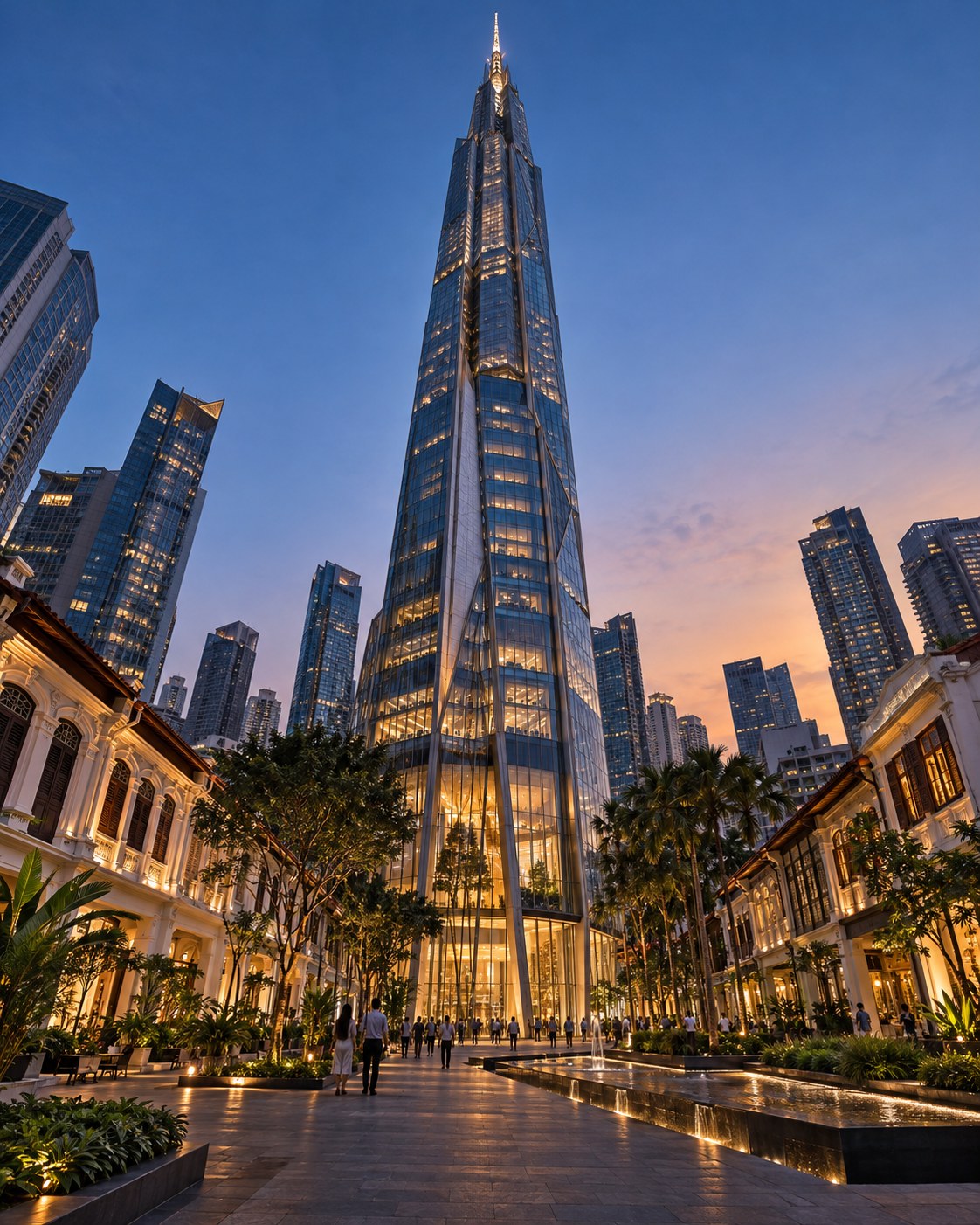
Kuala Lumpur’s newest landmark is 678.9 metres tall. It is also 700.9 metres tall. Both figures have circulated publicly, and both describe the same structure: the tower long known as Merdeka 118, officially renamed Menara Merdeka Maybank from 28 July 2026 after its anchor tenant moved in. The first number is measured from the ground. The second is measured from sea level.
Neither figure is wrong. They simply answer different questions. That is the core problem with height claims in property marketing. “Tallest”, “highest” and “the city’s new skyline icon” sound like plain facts, but every height figure depends on where the measurement starts, where it stops, what is being measured and when.
For buyers weighing a high-rise launch, tenants comparing premium office towers, and developers preparing a landmark campaign, understanding those rules separates a precise claim from an impressive-sounding one.
One building, three official heights
The most widely used international standard comes from the Council on Tall Buildings and Urban Habitat (CTBUH). Its criteria are now published on The Skyscraper Center under the Council on Vertical Urbanism name. The standard recognises three height categories, and all of them start from the same point: the lowest significant, open-air, pedestrian entrance to the building.
- Height to architectural top: measured to the top of the building’s architectural form, including spires. Antennae, signage, flagpoles and other functional-technical equipment are excluded. This is the figure used to rank the world’s tallest buildings.
- Height to highest occupied floor: measured to the finished floor level of the highest floor designed to be occupied regularly by residents, workers or visitors. Plant rooms and maintenance-only spaces do not count.
- Height to tip: measured to the highest point of the structure, whatever that element is, including antennae.
Shanghai Tower shows how far apart these figures can sit. Its architectural height and height to tip are both 632 metres. Its highest occupied floor is 583.4 metres above the entrance level, and its observatory is at 562.1 metres. A marketing line about “views from over 600 metres” would therefore be inaccurate, even though the building is genuinely over 600 metres tall.
| Height measure | What it captures | What it leaves out | Most useful for |
|---|---|---|---|
| Architectural top | The building’s designed form, including spires | Antennae, masts, signage, flagpoles | Official “tallest building” rankings |
| Highest occupied floor | The highest regularly usable floor | Spires, crowns, plant levels | Judging real views, usable height and premium-floor claims |
| To tip | The physical top of the structure | Nothing above ground | Aviation, engineering and “highest point” statements |
| Above sea level | Elevation of the top relative to the sea | The building’s own vertical extent | Geography and aviation contexts, not building rankings |
Where the tape measure starts matters
The standard deliberately does not start at sea level, at the lowest basement or at a sunken plaza. It starts at a pedestrian entrance that is open to the air and gives access to the building’s main uses. Car park entrances and service doors do not qualify. For towers on large podiums, the criteria allow some flexibility, but the principle is the same: height should reflect what a person standing at the building’s front door would experience.
This explains why figures for the same tower diverge in practice. When Tokyo’s Azabudai Hills Mori JP Tower was completed in 2023, the developer and wire reports described it as about 330 metres tall. Its architectural height is widely listed at 325.2 metres. Rounding, reference levels and the inclusion of rooftop elements can all account for a gap like that. A reader comparing towers should make sure every figure in the comparison uses the same basis.
A building is not the same as a tower
The standard also draws a line many marketing materials ignore. To count as a building, at least half of a structure’s height must be occupiable floor space. Structures below that threshold, such as telecommunications masts and observation towers, are excluded from building rankings.
Tokyo shows the distinction clearly. Tokyo Skytree, a 634-metre lattice tower completed in 2012, is far taller than any building in the city. Yet the Mori JP Tower, at roughly half that height, is correctly described as Japan’s tallest building, because the Skytree is a tower rather than a building. A developer that compares its project with a nearby communications tower is not comparing like with like.
Why floor counts are a weak proxy for height
Storey numbers are among the most visible figures in a high-rise sales gallery and among the least reliable. The CTBUH criteria note that floor counts often differ from published accounts. In some markets, certain floor numbers are skipped. Hong Kong commonly omits floors such as 4, 14 and 24. Owners and marketing teams may also number floors to suit their own objectives.
Floor-to-floor heights also vary widely. Office floors are generally taller than residential floors, and mechanical levels can be significantly taller. A residential tower and an office tower with the same storey count can therefore differ considerably in height. For buyers, the practical lesson is that “Level 50” in a brochure is a label, not a measurement. If height or view is part of what you are paying for, ask for the floor’s level in metres from the approved drawings.
The same caution applies to floor area. Our guide to how floor area is measured across Asia’s property markets explains why built-up, saleable and usable figures should never be mixed.
Proposed, topped out or completed?
A height claim is only as reliable as the status of the building behind it. The criteria define a sequence of stages:
- Proposed: a specific site, a professional design team and planning consent obtained or in progress. Height data at this stage is treated as unconfirmed.
- Under construction: site clearing is complete and foundation or piling work has begun.
- Structurally topped out: the highest element of the main structural frame is in place, but spires or parapets may not be.
- Architecturally topped out: fully clad, with the highest finished architectural elements installed.
- Completed: topped out structurally and architecturally, fully clad, and open for business or at least partially occupiable.
Timelines move. A 2023 report on the Mori JP Tower noted that a roughly 390-metre tower near Tokyo Station was expected to surpass it in fiscal 2027. Current listings put the completion of that project, Torch Tower, in 2028. Until such a building is complete, “future tallest” remains a plan, and developer schedules are targets rather than guarantees. Our explainer on what topping-out, CCC and handover actually mean covers why a construction milestone is not the same as a building that buyers can occupy.
“Tallest” always needs a category
Most legitimate height claims in Asian property are not about being the tallest building in the world, or even in a country. They are tallest within a defined category: a city, a district, a building function or a combination of features. Shibuya Scramble Square in Tokyo, a 47-storey mixed-use complex of about 230 metres that opened on 1 November 2019, is the tallest building in Shibuya. It is not the tallest in Tokyo, a title held by the 325.2-metre Mori JP Tower.
Shibuya Scramble Square is also an Asia Record holder for a tightly bounded height category. The official record title is published in Chinese and translates broadly as the tallest shopping mall with an observation deck in 2025. The narrowness is the point. A claim that specifies the building type (a shopping mall), a qualifying feature (an observation deck) and a period (2025) can be checked against a defined set of comparable buildings. “The tallest mall in Asia” or “the tallest building around” cannot.
The same logic underpins credible property recognition generally. Our analysis of how property companies should verify superlative claims sets out why the comparison group and measurement period must be fixed before a result is announced, not chosen afterwards.
The Height Claim Checklist
When a launch brochure, leasing deck or press release describes a building as the tallest, the highest or a new skyline record, these questions will tell you how much weight the claim can bear.
- Which height? Architectural top, highest occupied floor, tip or above sea level?
- Measured from where? The main pedestrian entrance, or a lower or higher reference point?
- Building or structure? Is at least half of its height occupiable, or is it closer to a tower or mast?
- Which status? Proposed, under construction, topped out or completed? Is the figure confirmed or a design target?
- Tallest among what? In a city, a country, a building type or a feature category? Which buildings are in the comparison?
- As of when? Is the comparison dated, and does it account for buildings under construction that may soon surpass it?
- What evidence exists? Approved drawings, surveyor’s reports, an independent database entry or a documented third-party assessment?
A claim that answers all seven questions clearly is usually trustworthy. A claim that answers none of them is decoration.
What height does not tell a buyer
Height is a measurable engineering and architectural achievement. It is not a measure of investment quality. A record-setting tower can still have units that are poorly laid out, overpriced for their location, expensive to maintain or slow to lease. Very tall buildings bring operating realities of their own, including complex lift systems, façade maintenance and specialised building services. These affect service charges and long-term costs.
Buyers should judge an individual unit on its own merits: price relative to comparable transactions, maintenance charges, the developer’s delivery record, rental demand in the area and their own financial position and holding period. A landmark address may support a project’s profile. It does not guarantee appreciation, rental income or resale demand.
For developers: evidence before adjectives
Developers planning a height-based campaign should settle the measurement basis before the marketing copy is written. In practice, that means:
- choosing the height category deliberately and naming it in all materials;
- using surveyed or as-built figures once available, rather than early design heights;
- keeping the comparison set and the date of comparison on file;
- labelling project status accurately at every stage; and
- keeping drawings, survey reports and any independent database entries together, so the claim can be checked later.
Where a building achieves something genuinely exceptional and clearly measurable, independent recognition can complement this evidence. Asia Record documents verified record breaking achievements across Asia, including built-environment milestones. Its verification process starts by defining the claim and its conditions, then assesses submitted evidence for measurability, consistency and verifiability. For developers wondering how to get an Asia Record for a height or construction achievement, the practical starting point is the same evidence file described above. The official Asia Record application sets out the submission steps.
Record recognition in Asia serves a different purpose from statutory processes. Asia Record certification of a measured achievement does not replace building plan approvals, structural certification, a certificate of completion and compliance, fire safety approvals or any other regulatory requirement. It is also distinct from business awards in Asia that judge design merit or brand reputation. Being an Asia Record holder for a height category documents that defined achievement. It is not an endorsement of the project’s units as investments.
For a wider view of how different kinds of industry recognition compare, see our guide to which real estate recognition actually means something.
The number behind the skyline
Asia now holds many of the world’s tallest buildings, and more are rising in Kuala Lumpur, Tokyo, Ho Chi Minh City, Jakarta and elsewhere. As the region’s skylines grow, height claims will keep appearing in launches, leasing campaigns and city branding. The useful habit for any reader is to treat a height as a measurement rather than a slogan. Ask which height, from where, at what stage, and compared with what. Precise claims survive those questions easily, and the rest tend to change shape once they are asked.