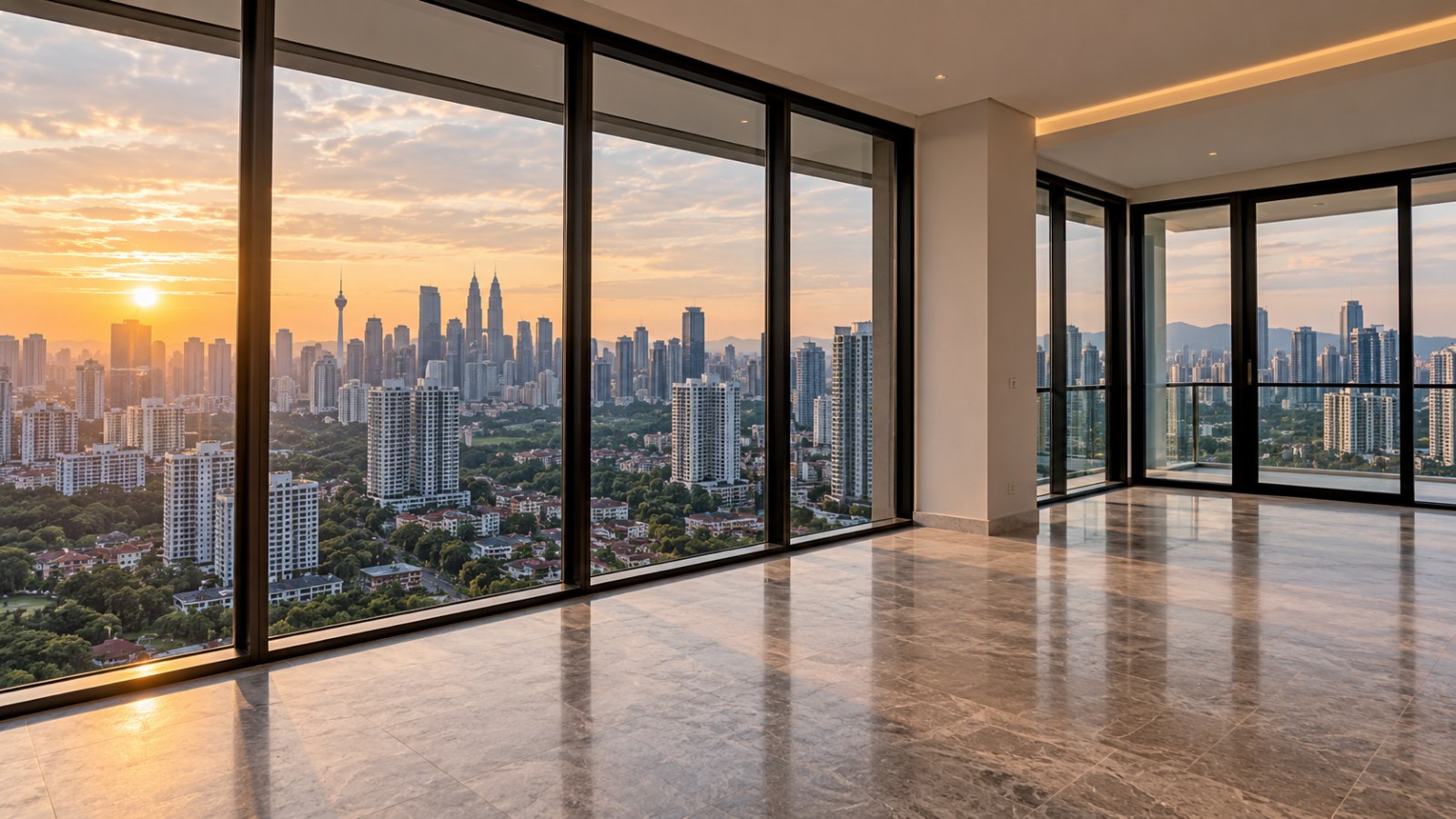
Walk through any high-end showroom in Kuala Lumpur, Penang or Johor Bahru and the vocabulary is remarkably consistent: luxury, prestige, exclusive, iconic, signature. The price tags usually start well above the national average. What the brochure rarely explains is the question every buyer at this level should be asking: which part of this price is paying for genuine quality, and which part is paying for the word “luxury”?
That question matters more in 2026 than it did a few years ago. Higher-priced homes are not automatically scarce, foreign buyers face higher entry costs, and the gap between a well-run premium building and an expensive but ordinary one tends to widen with age. This guide sets out a practical way to tell the difference.
“Luxury” Is a Marketing Word, Not a Property Category
There is no statutory definition of a luxury home in Malaysia. Official property statistics classify residential property by type, location and price range, not by prestige. Property consultancies track “high-end” condominiums using their own criteria, usually based on location, pricing and specification, and those criteria are not identical across firms.
Price itself is also a weak signal. Several factors can push a unit into a high price band without making it a better home:
- Land cost: a modest product on expensive city-centre land will carry a high price per square foot.
- Foreign-buyer price floors: each state sets a minimum purchase price for foreigners, commonly RM1 million or more for residential property in 2026. Some projects are priced around these thresholds because of who they are marketed to, not because of what they deliver.
- Marketing and brand fees: show galleries, overseas roadshows, celebrity endorsements and brand licensing all sit inside the selling price.
- Floor-area presentation: a headline price per square foot can look lower or higher depending on what area is being counted.
A premium price, in other words, tells you what the developer is asking. It does not tell you what you are getting.
What the Current Market Data Says About “Exclusivity”
Scarcity is one of the most common arguments behind premium pricing. Current data suggests buyers should test that argument rather than accept it.
According to the National Property Information Centre’s Property Market Report for the first half of 2026, Malaysia recorded 187,320 property transactions worth RM105.12 billion between January and June 2026, slightly lower than the 196,232 transactions recorded a year earlier. Over the same period, the number of completed but unsold residential units rose to 33,094, valued at RM17.78 billion, and more than half of those unsold units were priced between RM500,001 and RM1 million.
In the prime high-rise segment, Knight Frank Malaysia’s Real Estate Highlights 1H2026 put the stock of condominiums and serviced apartments in prime areas of the Klang Valley at 126,991 units, after 3,558 units were completed during the half-year. That is a large and still-growing pool of stock competing for the same pool of high-end buyers and tenants.
None of this means premium property is a poor choice. It means a project being “high-end” does not, on its own, make it rare. What makes a specific building scarce is a combination of attributes that competitors cannot easily copy—and those are what buyers should look for. For a wider discussion of interpreting these numbers, see our guide on how to read property market data in Asia without being misled.
The Premium Property Test: Six Layers to Check
A useful way to judge a luxury claim is to break it into six layers. Genuine premium property usually performs well on most of them. A project that relies on one or two—typically a famous address and a lavish lobby—deserves closer scrutiny.
| Layer | What a credible premium claim looks like | What to ask for | Warning sign |
|---|---|---|---|
| Location | A site with lasting advantages: views that cannot be built out, walkable access to transit and amenities, an established neighbourhood | Surrounding zoning and approved developments; existing (not proposed) transport links | “Future” views or stations described as if they already exist |
| Density | Fewer units per floor, fewer units per lift, sensible ratio of units to facilities | Total units, units per floor, number of passenger lifts, car park allocation | Hundreds of small units sharing the same “exclusive” facilities |
| Specification | Named, documented materials and fittings; ceiling heights, acoustic and window performance stated in the sale documents | The specification schedule attached to the sale and purchase agreement | Brand names shown in the show unit but not written into the contract |
| Space | Generous, usable layouts with clear floor-area definitions | Floor plans with dimensions; how built-up area is measured | A low price per square foot achieved by counting balconies, ledges or air-conditioner spaces |
| Services and management | Defined service scope, competent property management, healthy sinking fund | Management agreement, service charges, sinking fund levels in completed sister projects | Concierge and hotel-style services promised verbally, with no cost or contract behind them |
| Market evidence | Resale and rental transactions that support the premium over nearby comparables | Transacted prices (not asking prices) for the developer’s earlier projects and neighbouring buildings | Only launch prices, “indicative” valuations or projected appreciation figures |
Two of these layers deserve extra attention because they are the easiest to dress up.
Price per square foot depends on what is being measured
Premium projects are often compared on price per square foot, but the figure is only meaningful if the floor area is defined the same way. Large balconies, planter boxes and service areas can inflate the area figure and make a unit look better value than it is. Our explainer on how floor area is measured across Asia’s property markets sets out the differences buyers should check before comparing projects.
Management quality decides how a luxury building ages
A building that feels luxurious on handover day can feel ordinary within ten years if lifts, façades, pools and security are poorly maintained. The most reliable evidence of future quality is how the developer’s completed buildings are run today: service charge levels, maintenance standards, the state of common areas and the health of the sinking fund. The property management KPIs building owners should track are a useful checklist here.
Branded Residences: Read the Brand Agreement, Not the Logo
Residences carrying a hotel or lifestyle brand are now a familiar part of Kuala Lumpur’s high-end market. A brand can add real value when it brings defined operating standards and services. It can also be little more than a licensed name.
Before paying a brand premium, buyers should establish:
- whether the brand will actually operate or manage the residences, or simply licenses its name;
- which services are included in the service charge and which are paid separately;
- how long the brand arrangement runs, and what happens to the building’s name and services if it ends;
- who bears the cost of maintaining brand standards over time.
If the answers are not in writing, the brand premium is a marketing cost, not a property feature.
Foreign Buyers: Meeting the Threshold Is Not a Quality Test
For non-Malaysian buyers, premium pricing interacts with regulation. Each state sets its own minimum purchase price for foreigners, and state consent is required; meeting the threshold does not guarantee approval. Since 1 January 2026, under amendments to the Stamp Act 1949 made through the Finance Act 2025, the instrument transferring residential property to a non-citizen who is not a permanent resident attracts a flat 8% stamp duty, up from 4%. The same amendments clarified that serviced apartments and SOHO units used solely as dwellings count as residential property for stamp duty purposes.
The practical point is that a foreign buyer’s all-in cost is now materially higher than the headline price. That raises the bar for the premium itself: the property needs to justify not only its price but also the extra transaction costs. Buyers should confirm current state thresholds, consent requirements and duties with a Malaysian lawyer before signing anything.
Premium Agencies, Prestige Brands and Recognised Achievements
High-end property is increasingly sold through agencies that position themselves as specialists in the luxury or prestige segment. Some of these firms can point to measurable business milestones. M Century Properties, for example, is an Asia Record holder recognised for its 2025 title as the fastest-growing prestige real estate agency, an entry the official listing says is assessed against the stated record criteria and supporting evidence.
Recognition of this kind is meaningful for what it measures: business growth, organisational scale or another clearly defined benchmark. It tells buyers something about an agency’s commercial momentum. It does not certify the quality, value or investment prospects of any individual property the agency markets, and it does not replace an agent’s registration with the Board of Valuers, Appraisers, Estate Agents and Property Managers. Buyers should still apply the six-layer test to every unit, regardless of who is selling it. Our guide to reading agency growth claims in Asia explains how to interpret these milestones.
For agencies and developers, the lesson runs the other way. In a segment where every competitor describes itself as premium, specific and verifiable evidence carries more weight than adjectives. Firms with an exceptional, clearly measurable milestone—such as a defined growth rate, transaction benchmark or development scale—can seek business achievement recognition through independent record recognition in Asia. For those wondering how to get an Asia Record, the route is to apply for Asia Record with evidence of the achievement, how it was measured and the conditions under which it was achieved. Such record certification documents a business accomplishment; the property claims a firm makes to buyers still need their own evidence.
A Buyer’s Checklist Before Paying a Premium
- Compare the asking price with transacted prices of comparable completed buildings nearby, not with other launch prices.
- Confirm the floor-area definition used in the price per square foot, and calculate your own figure from the dimensioned floor plan.
- Check total units, units per floor and units per lift to understand true density.
- Make sure every promised material, fitting and facility appears in the specification schedule of the sale and purchase agreement.
- Visit, or review publicly available information on, the developer’s completed buildings that are at least five years old, and assess how they are being maintained.
- Ask for the projected service charge and sinking fund, and what services they actually cover.
- For branded projects, obtain the scope and duration of the brand or operator arrangement in writing.
- Distinguish between features that exist today and those that are proposed, planned or under construction—especially transport links and surrounding developments.
- For foreign buyers, confirm the state threshold, consent process and all duties with a lawyer before committing.
- Treat any projected rental yield or capital appreciation figure as a marketing estimate unless it is backed by an enforceable contract.
What a Premium Should Ultimately Buy
A genuine premium buys things that are hard to replicate and that last: a location advantage that cannot be built out, lower density, documented build quality, competent management and evidence that the market has valued these attributes in the past. A premium that rests mainly on branding, launch events and adjectives is a premium for marketing.
Property decisions also depend on factors no checklist can settle for you, including your financing, holding period, personal objectives and wider market conditions. Past price movements do not guarantee future returns, and a high-end label does not make any property immune to oversupply or weak resale demand. Buyers considering a significant purchase should seek independent legal, valuation and financial advice suited to their own circumstances.
For a broader starting point on assessing any residential purchase, see How to Choose the Right Property in Malaysia: 7 Things to Check Before Buying.